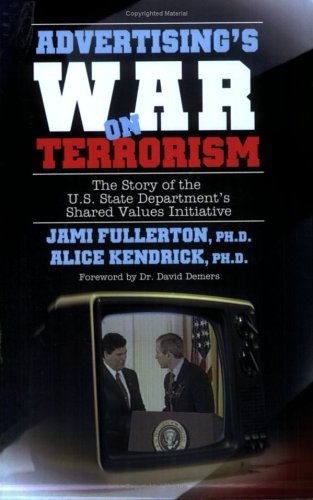


Advertising's War on Terrorism: The Story of the U.S. State Department's Shared Values Initiative
Price not available for France
You can still browse on Amazon. Try another country above.
Book Details
Author(s)
Jami Fullerton, Alice Kendrick
Publisher
Marquette Books
ISBN / ASIN
0922993440
ISBN-13
9780922993444
Marketplace
France 🇫🇷
Ratings & Reviews
No reviews yet — be the first!
No reviews yet.
Description
Did the Bush Administration Err In Shutting Down “Brand America†Ad Campaign? The Bush Administration missed an opportunity to improve America’s image in the Arab and Muslim world when it shut down the controversial 2002 “Brand America†public diplomacy television advertising campaign, according to a new book written by two U.S. advertising professors. Contrary to reports from the news media and from government at the time, the Shared Values Initiative (SVI)—the official name for the advertising campaign at the State Department—improved America’s image in Indonesia and possibly throughout the Middle East, according to Jami Fullerton of Oklahoma State University and Alice Kendrick of Southern Methodist University. “So, did SVI work?†the professors write in Advertising’s War on Terrorism: The Story of the U.S. State Department’s Shared Values Initiative. “According to internal State Department documents about SVI in Indonesia, the campaign achieved its objectives. It not only got people talking about Muslim life in America, it also produced more positive perceptions of America.†This finding also is backed up by experimental research the professors conducted in London, Cairo and Singapore. After viewing the five television advertisements, international students were more likely to believe Muslims are fairly treated in the United States and the students had more positive attitudes toward the “United States government†and “U.S. people.†The research also found that attitudes toward the United States improved more among Muslim students than among Christians and other students. The goal of SVI was to convince the Muslim and Arab world that America wasn’t waging war on Islam. The Madison Avenue-produced ads depicted the happy lives of Muslims in America, including Dr. Elias Zerhouni, director of the National Institutes of Health, who is shown on the cover of the book shaking hands with President George W. Bush. The commercials aired in Indonesia and other Middle Eastern and Asian countries over a month-long period between late October and early December! 2002. About 300 million Arabs and Muslims saw them. “Public diplomacy practitioners and scholars continue to lambaste SVI and the idea of using advertising as a weapon in the war on terrorism,†they write in the final chapter to their book. “The official account is that SVI failed. ... However, research presented in ... this book suggests that SVI may have worked. ... So the question becomes: If communication campaigns like SVI have the potential to be effective, what went wrong in 2002 and what can be done in the future to make similar public diplomacy programs work better?†The authors place much of the blame on State Department bureaucrats and on journalists, who at the time of the campaign denounced SVI, saying it didn’t work. The bureaucrats and journalists also criticized SVI’s creator, Charlotte Beers, a former advertising executive who created and directed the SVI campaign when she was under secretary of public diplomacy and public affairs at the State Department. However, the critics had no scientific evidence to back up their criticism, the authors point out. Instead, they suggest that Bush Administration officials acted more upon ideological and parochial prejudices rather than upon scientific evidence.
