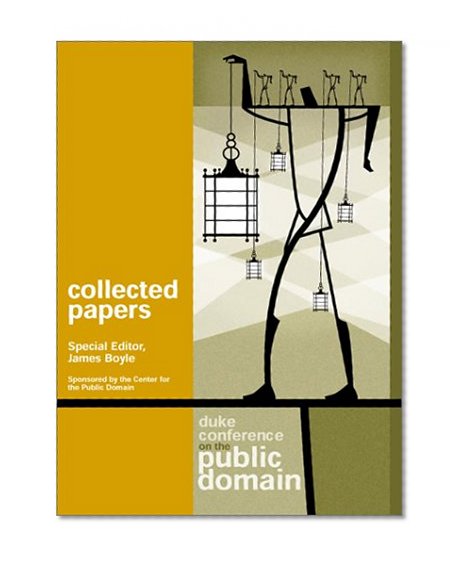


Collected Papers, Duke Conference on the Public Domain
What does the public domain do? What is its importance, its history, its role in science, art, and in the building of the Internet? How is the public domain similar to and different from the idea of a commons? Is it constitutionally protected, or required by the norms of free expression? This symposium, the first to focus on the public domain, seeks to answer those questions. Its topics range across a broad swath of innovation and creativity, from science and the Internet to music and culture jamming. Its list of authors includes prominent environmental scholars, appropriation artists, legal theorists, historians and literary critics.
The symposium is an edited version of the papers from a unique conference on the public domain at Duke University. Writing in the Financial Times, Patti Waldmeir described the event this way: "Professor Boyle brought together an elite group of intellectuals and scientists (and computer geeks) at Duke, hoping to launch a movement to protect the public domain. He argues that the inexorable advance of intellectual property law in recent years constitutes a ‘second enclosure movement’ to parallel the 18th-century enclosure of English common lands." In Technology Review magazine, Seth Shulman called the conference "an extraordinary meeting" and added: "In attendance were an eclectic array of actors from distinct intellectual-property battles…It was fascinating to see the sparks of commonality among this diverse group. Warning that greed and shortsightedness threaten to despoil innovation the way a previous frontier-minded generation despoiled the natural environment, a series of speakers urged the group to consider itself as an environmental movement for the new millennium – guarding collectively against the encroachment of proprietary intellectual-property rights."
The focus of the symposium is particularly timely. The New York Times said of a recent Supreme Court decision that it made it "likely that we are seeing the beginning of the end of public domain and the birth of copyright perpetuity. Public domain has been a grand experiment, one that should not be allowed to die. The ability to draw freely on the entire creative output of humanity is one of the reasons we live in a time of such fruitful creative ferment." The articles assembled here are both an indispensable guide to this "grand experiment" and a fascinating contribution to the creative ferment it enables.
