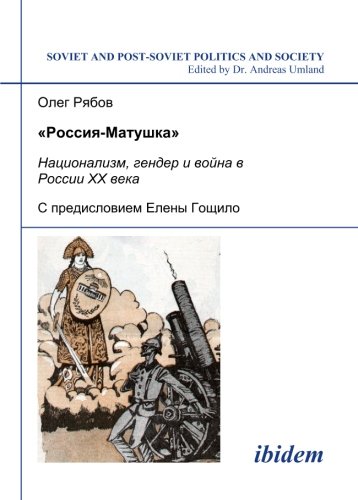


''Rossiia-Matushka'': Natsionalizm, gender i voina v Rossii XX veka (Soviet and Post-Soviet Politics and Society 60) (Volume 60) (Russian Edition)
Book Details
Author(s)Oleg Riabov
ISBN / ASIN3898214877
ISBN-139783898214872
AvailabilityUsually ships in 24 hours
Sales Rank5,134,337
MarketplaceUnited States 🇺🇸
Description
"This monograph is devoted to 'Mother Russia' as a principal concept of Russian nationalism. The volume demonstrates the role of the mythology of 'Mother Russia' in inventing and reinventing Russianness, in producing Ours and Theirs, in constructing external and internal Enemies, in legitimating and delegitimating power within the political system of Russia. Chapter I 'Nationalism, Gender, and War: A Methodological Framework' starts with definitions of the study's key terms - gender, nationalism, identity, and discourse. Interpreting gender as a referential, context-dependent and heterogeneous phenomenon as well as showing its implication in power relations, the author demonstrates that all principal concepts of nationalism as a discursive formation intersect with gender discourse. This, on the one hand, comes about through the role of nationalism in the formation of gender order during Modernity, and, on the other hand, through the potential of gender to serve as an effective marker facilitating the process of inclusion and exclusion in the making of collective identity. The author argues that gender discourse serves as a weapon of war, playing an important role in national mobilization, as well as in the assertion of supremacy in war, both militarily and morally. The aim of Chapter II '""Mother Russia"" Through the Lenses of Postcolonial Studies' is a general explanation of the symbol. 'Mother Russia' is rooted in a myth-symbol complex of Russian culture. At the same time, it has also been developed under the influence of the discourse on Modernity that has divided the world into 'the West and the Rest'. In Western culture, 'Mother Russia' serves as a 'symbolic border-guard' between a 'masculine' West and 'feminine' Russia.
