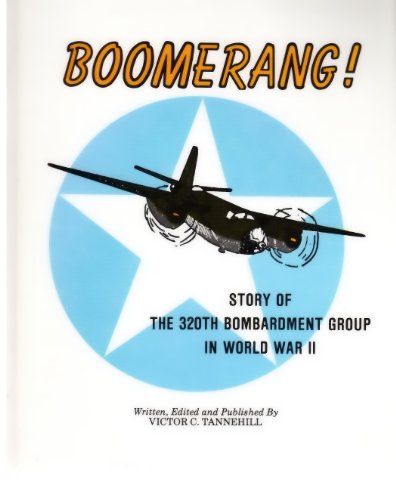


Boomerang!: Story of the 320th Bombardment Group in World War II
Book Details
Author(s)
Victor C Tannehill
Publisher
Tannehill
ISBN / ASIN
B0006DXWD8
ISBN-13
978B0006DXWD4
Sales Rank
#8,817,925
Marketplace
United States 🇺🇸
Description
"Boomerang" is the story of the air and ground crews who served with the U.S. Army Air Forces' 320th Bombardment Group and its squadrons (441st, 442nd, 443rd and 444th) during World War II.
Activated in June, 1942, at MacDill Field, Tampa, Florida, the 320th trained on Martin B-26 Marauder twin-engined medium bombers. Ordered overseas, its Ground Echelon sailed to England in September, and, following the November TORCH landings in North Africa, continued on to Tafaroui Airfield, Oran, Algeria. Air crews flew their planes from Florida across the South Atlantic , arriving at Tafaroui in December.
Moving forward to desert airstrips, the 320th began combat in the Mediterranean Theater of Operations (MTO) with the Twelfth Air Force, 42nd Bomb Wing, in April, 1943. Their yellow-tailed Marauders flew missions against Axis shipping and installations until German and Italian forces surrendered North Africa in May.
In June the 320th assisted in the reduction of the mid-Med islands of Pantelleria and Lampedusa and then provided air support for Seventh Army's July landings on Sicily.
The group bombed marshalling yards, bridges, airfields, road junctions, viaducts, harbors, fuel dumps and defensive positions in Southern Italy prior to Fifth Army landings at Salerno in September.
Shifting to Decimomannu airbase on Sardinia in November, the 320th continued to send out missions in support of advancing Allied ground forces. Achieving the lowest loss-per-sortie record of any B-26 group earned them their nicname: "Boomerangs".
The group knocked out tactical targets in Italy to aid Fifth Army's landings at Anzio-Nettuno January 22, 1944. It was awarded a Distinguished Unit Citation (DUC) for its mission of May 12, 1944: 320th B-26s accurately bombed German troop and panzer concentrations near Fondi to stop a potential counterattack. All three of the MTO Marauder groups--the 17, 319th and 320th--were awarded the Croix de Guerre with Palm for aiding French troops break through the Gustav Line at Cassino.
Marauders of the 320th carried out pre-invasion attacks on harbors, bridges, railways and roads along the Riviera Coast prior to the DRAGOON landings in Southern France August 15, 1944. The group moved to Alto, Corsica, in September. Operations included long interdictory missions to targets in the Po Valley and German supply and communication lines in far northeastern Italy.
Assigned to the First Tactical Air Force (Provisional) in November, the 320th moved from the MTO to the European Theater of Operations (ETO). Based at Dijon and later Dole in southeastern France, the group supported Sixth Army Group's Seventh Army--despite record-breaking snow, ice, cold and rain. It received a second DUC for its mission of March 15, 1945, when its B-26s precision-bombed "dragon's teeth" Siegfried Line defenses near Zweibrucken, Germany.Â
The 320th's Marauders continued to hit bridges, rail lines, gun positions, barracks, supply points and ammunition dumps until V-E Day in May. After completing disarmament duties, the group returned to the U.S. in November and was inactivated December 4, 1945.
For this unit history, Tannehill draws on Official records, group and squadron daily diaries, interviews with 320th veterans and wartime media reports. "Boomerang's" pages are filled with photographs--nearly 500 of them--most never before published of people, places and planes, plus maps and artwork. The book is 8 1/2" x 11" x 3/4", hardbound with "yearbook-style" covers in color.
Activated in June, 1942, at MacDill Field, Tampa, Florida, the 320th trained on Martin B-26 Marauder twin-engined medium bombers. Ordered overseas, its Ground Echelon sailed to England in September, and, following the November TORCH landings in North Africa, continued on to Tafaroui Airfield, Oran, Algeria. Air crews flew their planes from Florida across the South Atlantic , arriving at Tafaroui in December.
Moving forward to desert airstrips, the 320th began combat in the Mediterranean Theater of Operations (MTO) with the Twelfth Air Force, 42nd Bomb Wing, in April, 1943. Their yellow-tailed Marauders flew missions against Axis shipping and installations until German and Italian forces surrendered North Africa in May.
In June the 320th assisted in the reduction of the mid-Med islands of Pantelleria and Lampedusa and then provided air support for Seventh Army's July landings on Sicily.
The group bombed marshalling yards, bridges, airfields, road junctions, viaducts, harbors, fuel dumps and defensive positions in Southern Italy prior to Fifth Army landings at Salerno in September.
Shifting to Decimomannu airbase on Sardinia in November, the 320th continued to send out missions in support of advancing Allied ground forces. Achieving the lowest loss-per-sortie record of any B-26 group earned them their nicname: "Boomerangs".
The group knocked out tactical targets in Italy to aid Fifth Army's landings at Anzio-Nettuno January 22, 1944. It was awarded a Distinguished Unit Citation (DUC) for its mission of May 12, 1944: 320th B-26s accurately bombed German troop and panzer concentrations near Fondi to stop a potential counterattack. All three of the MTO Marauder groups--the 17, 319th and 320th--were awarded the Croix de Guerre with Palm for aiding French troops break through the Gustav Line at Cassino.
Marauders of the 320th carried out pre-invasion attacks on harbors, bridges, railways and roads along the Riviera Coast prior to the DRAGOON landings in Southern France August 15, 1944. The group moved to Alto, Corsica, in September. Operations included long interdictory missions to targets in the Po Valley and German supply and communication lines in far northeastern Italy.
Assigned to the First Tactical Air Force (Provisional) in November, the 320th moved from the MTO to the European Theater of Operations (ETO). Based at Dijon and later Dole in southeastern France, the group supported Sixth Army Group's Seventh Army--despite record-breaking snow, ice, cold and rain. It received a second DUC for its mission of March 15, 1945, when its B-26s precision-bombed "dragon's teeth" Siegfried Line defenses near Zweibrucken, Germany.Â
The 320th's Marauders continued to hit bridges, rail lines, gun positions, barracks, supply points and ammunition dumps until V-E Day in May. After completing disarmament duties, the group returned to the U.S. in November and was inactivated December 4, 1945.
For this unit history, Tannehill draws on Official records, group and squadron daily diaries, interviews with 320th veterans and wartime media reports. "Boomerang's" pages are filled with photographs--nearly 500 of them--most never before published of people, places and planes, plus maps and artwork. The book is 8 1/2" x 11" x 3/4", hardbound with "yearbook-style" covers in color.
