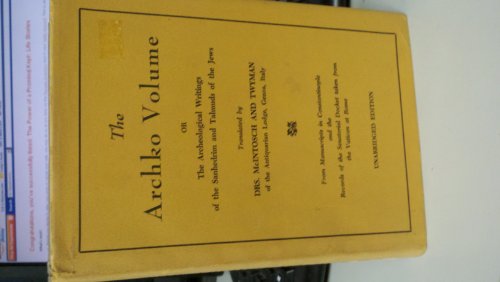


Archko Volume - Or, The Archeological Writings Of The Sanhedrim And Talmuds Of The Jews... - Unabridged Edition
Price not available for India
You can still browse on Amazon. Try another country above.
Book Details
Author(s)
Translated by Drs. Mcintosh & Twyman
Publisher
Archko Press
ISBN / ASIN
B002JDZ1FU
ISBN-13
978B002JDZ1F9
Marketplace
India 🇮🇳
Ratings & Reviews
No reviews yet — be the first!
No reviews yet.
Description
In 1884 Mahan published the first version of the Archko Volume, entitled The Archaeological Writings of the Sanhedrin and Talmuds of the Jews, Taken from the Ancient Parchments and Scrolls at Constantinople and the Vatican at Rome, Being the Record Made by the Enemies of Jesus of Nazareth in His Day: The Most Interesting History Ever Read by Man. This included an expanded version of "Pilate's Court" plus a series of other texts that he claimed to have obtained himself in a visit to Rome and Constantinople and translated with the aid of Dr. M. McIntosh of Scotland and Dr. Twyman of England, also otherwise unheard of.[6] These texts include interviews with the shepherds, Gamaliel's interview with Joseph and Mary, Caiaphas's reports to the Sanhedrin, Eli's story of the Magi, Herod Antipater's defense before the Senate for the slaughter of the innocents, and Herod Antipas's defense before the Senate-all with the claim that they were copied from ancient manuscripts and translated into English.[7]
The texts are otherwise unknown to scholarship, and the volume contains various inconsistencies. It quotes an unknown Greek philosopher, "Meeleesen," and includes references to Josephus that do not exist. It mistakenly asserts that Philo spoke often of Jesus and that "the scribes of those days were most all Rabbis." There are inaccurate descriptions of the library of the Hagia Sophia in Constantinople, the making of papyrus, and an inaccurate chronology for both Philo and Tacitus. Contemporaries raised the question of whether Mahan could have possibly made the trip to Rome and Constantinople in the timeframe he claimed, less than two months. Most tellingly, large chunks of "Eli and the Story of the Magi" were copied verbatim from the 1880 novel Ben-Hur. At one point, a strange word reveals that a single line of the printed text of Ben-Hur has accidentally been omitted during copying.
