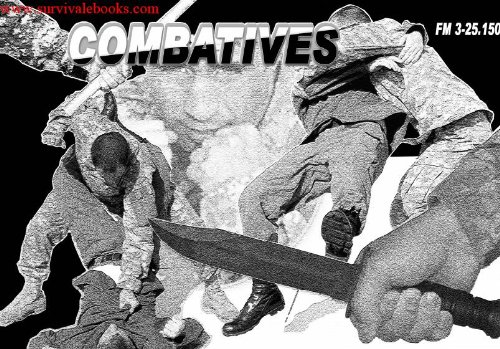


Field manual, Combatives, FM-3-25-150, 2009, hand to hand combat, fighting, boxing, close combat, military manuals, army manuals
Price not available for Germany
You can still browse on Amazon. Try another country above.
Book Details
Author(s)
U.S. Army and www.survivalebooks.com
Publisher
U.S. Army and www.survivalebooks.com
ISBN / ASIN
B003RWS76W
ISBN-13
978B003RWS764
Marketplace
Germany 🇩🇪
Ratings & Reviews
No reviews yet — be the first!
No reviews yet.
Description
PURPOSE
1-1. Combatives, the art of hand-to-hand combat, bridges the gap between physical training and tactics. The products of a good physical training plan—strength, endurance, and flexibility—must be directed
toward the mission, and Soldiers must be prepared to use different levels of force in an environment where the intensity of a conflict changes quickly. Many military operations, such as peacekeeping missions or noncombatant evacuation, may restrict the use of deadly weapons. Combatives training saves lives when an unexpected confrontation occurs.
1-2. Combatives training includes arduous physical training that is mentally demanding and carries over to other military pursuits. This training produces Soldiers who—
Understand controlled aggression and remain focused while under duress.
Possess the skills requisite to the mission, at all levels in the spectrum of force.
Have the attributes that make up the Warrior Ethos—
personal courage, self-confidence, self-discipline, and esprit de corps.
1-3. Throughout modern history, attempts to build a successful combatives system have failed or have been met with limited success. This has happened for several reasons. Quite naturally, commanders desire a system that doesn’t require any training time to learn and maintain. Further, training has often been conducted by experts in civilian martial arts. These experts use training methodologies that are designed more for the civilian hobbyist than the realities of war.
1-4. Often, combatives training has been approached by allowing a Soldier versed in a civilian martial art to use a limited amount of training time, usually during another course (such as initial entry training [IET] or specialist training), to teach a useful technique. Blinded by his civilian training, the trainer demonstrates what he thinks are simple, effective, and easy-to-learn techniques selected based on a
situation Soldiers may find themselves in or the tactical niche of the specialist training. He teaches the Soldiers these techniques, but due to the limited amount of training time, the Soldiers quickly forget them.
To overcome these tendencies, a combatives training system must be based on certain principles, and then maintained. These principles are—
Systematic training.
Foundation.
Continuous training.
Competition.
Drills.
Live training.
Integrated training.
Combat feedback.
SYSTEMATIC TRAINING
1-5. Learning to fight is a process, not an event. To be effective, combatives training must be part of a system. Until Soldiers learn the techniques that form the system's foundation, they are unprepared for
follow-on training; short cuts or teaching Soldiers “what they need to know” is counterproductive, much as advanced tactical training is counterproductive if a Soldier has not first been taught how to operate his weapon. Army combatives training must be based in a system that both lays a foundation of abilities that Soldiers take with them
wherever they are assigned and is flexible enough to fit the wide range of specialized missions Soldiers and units are asked to perform.
FOUNDATION
1-6. Army institutional training should build a foundation for combatives training. Training should concentrate on the fundamentals of the combatives system—from learning basic combatives techniques
in IET and advanced individual training (AIT) to leading a successful unit program in the leadership courses of the Noncommissioned Officer Education System (NCOES) and Officer Education System (OES).
CONTINUOUS TRAINING
1-7. Combatives training must not end upon graduation from a training course. For Soldiers to develop their abilities, the majority of the training must happen outside of the institutional training
environment. Units must develop their own combatives programs to spur troop involvement and encourage commanders to invest resources.
1-1. Combatives, the art of hand-to-hand combat, bridges the gap between physical training and tactics. The products of a good physical training plan—strength, endurance, and flexibility—must be directed
toward the mission, and Soldiers must be prepared to use different levels of force in an environment where the intensity of a conflict changes quickly. Many military operations, such as peacekeeping missions or noncombatant evacuation, may restrict the use of deadly weapons. Combatives training saves lives when an unexpected confrontation occurs.
1-2. Combatives training includes arduous physical training that is mentally demanding and carries over to other military pursuits. This training produces Soldiers who—
Understand controlled aggression and remain focused while under duress.
Possess the skills requisite to the mission, at all levels in the spectrum of force.
Have the attributes that make up the Warrior Ethos—
personal courage, self-confidence, self-discipline, and esprit de corps.
1-3. Throughout modern history, attempts to build a successful combatives system have failed or have been met with limited success. This has happened for several reasons. Quite naturally, commanders desire a system that doesn’t require any training time to learn and maintain. Further, training has often been conducted by experts in civilian martial arts. These experts use training methodologies that are designed more for the civilian hobbyist than the realities of war.
1-4. Often, combatives training has been approached by allowing a Soldier versed in a civilian martial art to use a limited amount of training time, usually during another course (such as initial entry training [IET] or specialist training), to teach a useful technique. Blinded by his civilian training, the trainer demonstrates what he thinks are simple, effective, and easy-to-learn techniques selected based on a
situation Soldiers may find themselves in or the tactical niche of the specialist training. He teaches the Soldiers these techniques, but due to the limited amount of training time, the Soldiers quickly forget them.
To overcome these tendencies, a combatives training system must be based on certain principles, and then maintained. These principles are—
Systematic training.
Foundation.
Continuous training.
Competition.
Drills.
Live training.
Integrated training.
Combat feedback.
SYSTEMATIC TRAINING
1-5. Learning to fight is a process, not an event. To be effective, combatives training must be part of a system. Until Soldiers learn the techniques that form the system's foundation, they are unprepared for
follow-on training; short cuts or teaching Soldiers “what they need to know” is counterproductive, much as advanced tactical training is counterproductive if a Soldier has not first been taught how to operate his weapon. Army combatives training must be based in a system that both lays a foundation of abilities that Soldiers take with them
wherever they are assigned and is flexible enough to fit the wide range of specialized missions Soldiers and units are asked to perform.
FOUNDATION
1-6. Army institutional training should build a foundation for combatives training. Training should concentrate on the fundamentals of the combatives system—from learning basic combatives techniques
in IET and advanced individual training (AIT) to leading a successful unit program in the leadership courses of the Noncommissioned Officer Education System (NCOES) and Officer Education System (OES).
CONTINUOUS TRAINING
1-7. Combatives training must not end upon graduation from a training course. For Soldiers to develop their abilities, the majority of the training must happen outside of the institutional training
environment. Units must develop their own combatives programs to spur troop involvement and encourage commanders to invest resources.