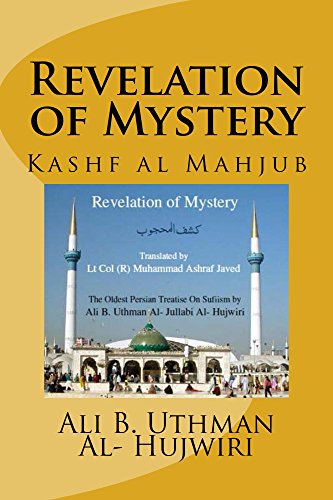


Revelation of Mystery (Kashf Al Mahjub)
Price not available for United Kingdom
You can still browse on Amazon. Try another country above.
Book Details
Author(s)
Ali B. Uthman Al- Jullabi Al- Hujwiri
ISBN / ASIN
B00452VGMA
ISBN-13
978B00452VGM1
Marketplace
United Kingdom 🇬🇧
Ratings & Reviews
No reviews yet — be the first!
No reviews yet.
Description
All Praises be to Allah, who hath revealed the secrets of His kingdom to His Auliya (Saints), and hath manifested the mysteries of His Almightiness to His intimates, and hath shed the blood of Lovers with the sword of His Glory, and hath let the hearts of Gnostics taste the joy of His union! He is Who bringeth dead hearts to life by the splendor of the perception of His Eternity and Majesty, and breathes them with the comforting spirit of Marifat (knowledge of Allah) by divulging His Names. And peace be upon His Prophet Muhammad, and his family and his companions and his wives!
Kashaf al-Mahjub is one of the oldest Persian treatises on Mysticism. It was written around mid of eleventh century. The original work is in Persian and it has been translated into many Oriental and European languages. The Manuscripts of the Kashaf al-Mahjub are preserved in several Asian and European libraries which includes 900 years old manuscripts also. The author composed many titles to which he has occasion to refer in the Kashaf al-Mahjub but none of his works except Kashaf al-Mahjub have been preserved.
Abu al-Hasan Ali b. Uthman b. Abi Ali al-Jullabi al-Ghaznavi al-Hujwiri (may Allah be pleased with him) was born in a noble family of Ghazna which was renowned for their piety and countenance. His lineage reaches to Ali through Hasan (may Allah be pleased with them). He was a Sunni Hanafite and in mystic way followed Junaid and was the disciple of Abu al-Fadl Muhammad b. al Hasan al-Khuttali. In his novitiate days he widely traveled in most parts of the Islamic Empire and graced himself with the knowledge of mystic path. He met many highly reputed Sheikhs of his time and benefited from their experiences. For some time he had a settled life in Iraq, where he ran deeply into debt. Finally, around 431 A.H. in the reign of Mahmud Ghaznavi he along with Abu Said Hujwiri and Hammad Sarkhasi came to Lahore and ended his days in that city. He died in 465 A.H. and buried there. His tomb at Lahore is visited by the multitudes that go there to seek their desires. The prayers are granted there. He is popularly remembered as Data Gang Baksh (the generous).
The Kashf al-Mahjub, belongs to the later years of the author’s life, and was written on the request of a fellow-townsman, Abu Said al-Hujwiri. Its object seems to set forth a complete system of Sufism, and the author’s attitude throughout remains that of a teacher instructing a student. Even the biographical section of the work is largely expository. Before stating his own view the author examines the current opinions on the same topic and refutes them if necessary. The discussion of mystical problems and controversies is enlivened by many illustrations drawn from his personal experiences. The author keeping in mind the ordinary seeker has avoided any philosophical and intellectual discussion and in a very simple and Quranic way has desired seekers to follow Quran and Sunnah in their true spirit and totally denies any act falling out of the bounds of Quran and Sunnah. It maintains equilibrium in Shariat and Mysticism. He very often warns his readers that none follower of the path including those who have attained the highest degree of holiness, are exempt from the obligation of obeying the Shariat. The centre point of Kashaf al-Mahjub is that the man should annihilate himself in the essence of the Truth to such an extent that none of his act should take place through his own thoughts or efforts, rather it should emerge as acts of the Divine and his own condition should be mere of a puppet which only works through the movements of string controlled by its owner.
It will not be a boasting opinion to mention Kashaf al-Mahjub as the primary source on the laws of mysticism. It elaborates all the stages of the Path of Sufism in such a manner that in the words of the author the seeker studying and following the book would not need the auspicious guidance of a Sheikh (spiritual guide). He ha
Kashaf al-Mahjub is one of the oldest Persian treatises on Mysticism. It was written around mid of eleventh century. The original work is in Persian and it has been translated into many Oriental and European languages. The Manuscripts of the Kashaf al-Mahjub are preserved in several Asian and European libraries which includes 900 years old manuscripts also. The author composed many titles to which he has occasion to refer in the Kashaf al-Mahjub but none of his works except Kashaf al-Mahjub have been preserved.
Abu al-Hasan Ali b. Uthman b. Abi Ali al-Jullabi al-Ghaznavi al-Hujwiri (may Allah be pleased with him) was born in a noble family of Ghazna which was renowned for their piety and countenance. His lineage reaches to Ali through Hasan (may Allah be pleased with them). He was a Sunni Hanafite and in mystic way followed Junaid and was the disciple of Abu al-Fadl Muhammad b. al Hasan al-Khuttali. In his novitiate days he widely traveled in most parts of the Islamic Empire and graced himself with the knowledge of mystic path. He met many highly reputed Sheikhs of his time and benefited from their experiences. For some time he had a settled life in Iraq, where he ran deeply into debt. Finally, around 431 A.H. in the reign of Mahmud Ghaznavi he along with Abu Said Hujwiri and Hammad Sarkhasi came to Lahore and ended his days in that city. He died in 465 A.H. and buried there. His tomb at Lahore is visited by the multitudes that go there to seek their desires. The prayers are granted there. He is popularly remembered as Data Gang Baksh (the generous).
The Kashf al-Mahjub, belongs to the later years of the author’s life, and was written on the request of a fellow-townsman, Abu Said al-Hujwiri. Its object seems to set forth a complete system of Sufism, and the author’s attitude throughout remains that of a teacher instructing a student. Even the biographical section of the work is largely expository. Before stating his own view the author examines the current opinions on the same topic and refutes them if necessary. The discussion of mystical problems and controversies is enlivened by many illustrations drawn from his personal experiences. The author keeping in mind the ordinary seeker has avoided any philosophical and intellectual discussion and in a very simple and Quranic way has desired seekers to follow Quran and Sunnah in their true spirit and totally denies any act falling out of the bounds of Quran and Sunnah. It maintains equilibrium in Shariat and Mysticism. He very often warns his readers that none follower of the path including those who have attained the highest degree of holiness, are exempt from the obligation of obeying the Shariat. The centre point of Kashaf al-Mahjub is that the man should annihilate himself in the essence of the Truth to such an extent that none of his act should take place through his own thoughts or efforts, rather it should emerge as acts of the Divine and his own condition should be mere of a puppet which only works through the movements of string controlled by its owner.
It will not be a boasting opinion to mention Kashaf al-Mahjub as the primary source on the laws of mysticism. It elaborates all the stages of the Path of Sufism in such a manner that in the words of the author the seeker studying and following the book would not need the auspicious guidance of a Sheikh (spiritual guide). He ha

