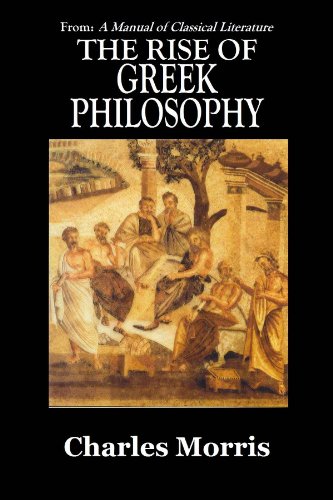
THE RISE OF GREEK PHILOSOPHY
Book Details
Author(s)Charles Morris
PublisherEvergreen Review, Inc.
ISBN / ASINB004G8OYEA
ISBN-13978B004G8OYE0
MarketplaceIndia 🇮🇳
Description
Contents:
Introductory
Socrates
Plato
Aristotle
The Later Philosophy
The Grecian School of Oratory
Lysias
Isocrates
Isæus
Demosthenes
Æschines
***
an excerpt from the chapter about:
SOCRATES.
BORN 469 B.C.
This most remarkable of the Grecian philosophers, and, in some respects, the greatest mind produced by ancient Greece, was the son of Sophroniscus, a sculptor, whose profession the future philosopher followed for many years, and not without skill. Pausanias speaks of having seen upon the Acropolis three draped figures of the Graces, which were said to be the work of Socrates.
Little further is known of his early education. He seems to have had no personal connection with any of the noted philosophers, and to have pinned his faith to none of the preceding schools. For this reason his teachings form a new era in the history of philosophy. The period in which he first became prominent in this new field can only be fixed as previous to the production of the Clouds of Aristophanes, in which he was so severely satirized. This was in the year 423, when he was forty-six years old.
His remarkable personal appearance made him a fair mark for the comedians shafts of ridicule. His crooked, turned-up nose, his projecting eye, his bald head and corpulent body, gave occasion for the comparison of his form with that of the satyr Silenus. To this was added his miserable dress, his habit of going barefoot, and of often standing still and rolling his eyes. His domestic relations, too, were calculated to inspire the ridicule of his enemies; for Xanthippe, his wife, is celebrated as the premium scold of history, and, if all that is related of her be true, must have rendered his indoor life decidedly uncomfortable.
In physical constitution Socrates was robust to an unusual degree; enabling him to endure the hardest military service, and to live superior to all wants beyond the barest necessaries of life. He served as a hoplite, or heavy-armed foot-soldier, at the siege of Potidæa, at the battle of Delium, and at Amphipolis. In these engagements his valor and endurance were greatly extolled. In the first he saved the life of Alcibiades, and in the second that of Xenophon, two of his most distinguished pupils.
On two memorable occasions he stood forth in political life. After the battle of Arginusæ, in 406, the ten generals in command were tried for failing to obtain the bodies of the killed, in order that they might receive the rites of interment. Such was the public clamor against them that the court wished to hasten their trial in violation of the ordinary legal forms; but Socrates, as the presiding judge, firmly refused to put the question. The other occasion was during the rule of the thirty tyrants, who attempted to force a number of influential citizens to take part in their illegal murders and confiscations. Socrates withstood them at the peril of his own life.
Introductory
Socrates
Plato
Aristotle
The Later Philosophy
The Grecian School of Oratory
Lysias
Isocrates
Isæus
Demosthenes
Æschines
***
an excerpt from the chapter about:
SOCRATES.
BORN 469 B.C.
This most remarkable of the Grecian philosophers, and, in some respects, the greatest mind produced by ancient Greece, was the son of Sophroniscus, a sculptor, whose profession the future philosopher followed for many years, and not without skill. Pausanias speaks of having seen upon the Acropolis three draped figures of the Graces, which were said to be the work of Socrates.
Little further is known of his early education. He seems to have had no personal connection with any of the noted philosophers, and to have pinned his faith to none of the preceding schools. For this reason his teachings form a new era in the history of philosophy. The period in which he first became prominent in this new field can only be fixed as previous to the production of the Clouds of Aristophanes, in which he was so severely satirized. This was in the year 423, when he was forty-six years old.
His remarkable personal appearance made him a fair mark for the comedians shafts of ridicule. His crooked, turned-up nose, his projecting eye, his bald head and corpulent body, gave occasion for the comparison of his form with that of the satyr Silenus. To this was added his miserable dress, his habit of going barefoot, and of often standing still and rolling his eyes. His domestic relations, too, were calculated to inspire the ridicule of his enemies; for Xanthippe, his wife, is celebrated as the premium scold of history, and, if all that is related of her be true, must have rendered his indoor life decidedly uncomfortable.
In physical constitution Socrates was robust to an unusual degree; enabling him to endure the hardest military service, and to live superior to all wants beyond the barest necessaries of life. He served as a hoplite, or heavy-armed foot-soldier, at the siege of Potidæa, at the battle of Delium, and at Amphipolis. In these engagements his valor and endurance were greatly extolled. In the first he saved the life of Alcibiades, and in the second that of Xenophon, two of his most distinguished pupils.
On two memorable occasions he stood forth in political life. After the battle of Arginusæ, in 406, the ten generals in command were tried for failing to obtain the bodies of the killed, in order that they might receive the rites of interment. Such was the public clamor against them that the court wished to hasten their trial in violation of the ordinary legal forms; but Socrates, as the presiding judge, firmly refused to put the question. The other occasion was during the rule of the thirty tyrants, who attempted to force a number of influential citizens to take part in their illegal murders and confiscations. Socrates withstood them at the peril of his own life.


