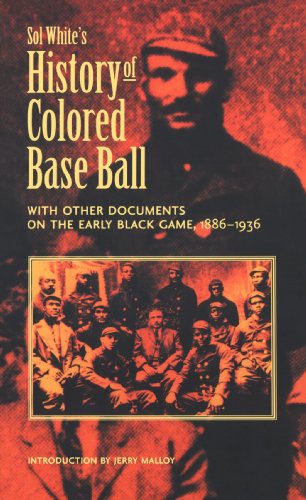


Sol White's History of Colored Baseball with Other Documents on the Early Black Game, 1886-1936
You can still browse on Amazon. Try another country above.
No reviews yet.
What makes this such a revealing document, archival necessity, and historical curiosity is how accepted the idea of a separate baseball universe was almost from baseball's organized start, and how hard White worked to make sure its accomplishments wouldn't just disappear unrecorded; the purpose of his History was to celebrate, advertise, and raise money for this separate universe. It's not a sociology text, though it will provide a grand slam of sociology for contemporary readers, nor is it an angry screed in search of a soapbox, but its resignation is hard to miss: "The colored ballplayer," writes White, "should always look before he leaps. He should remember that, although possessing the ability in every particular of the white ball player, he is not in a position to demand the same salary as his white brother, as the difference in the receipts of their respective games are decidedly in favor of the latter."
In a long, probing introductory essay, Negro League historian Jerry Malloy provides important context to the content of White's work. And while White's History stands on its own, Malloy adds an intriguing array of supporting documents, including some of White's later observations on the game; an 1892 account from the Cleveland Gazette identifying the prejudice of Cap Anson, the Hall of Famer most responsible for establishing the game's color line; and a column from the April 11, 1891, issue of Sporting Life that begins with the already shameful realization that, "Probably in no other business in America is the color line so finely drawn as in base ball. An African who attempts to put on a uniform and go in among a lot of white players is taking his life in his hands." --Jeff Silverman

