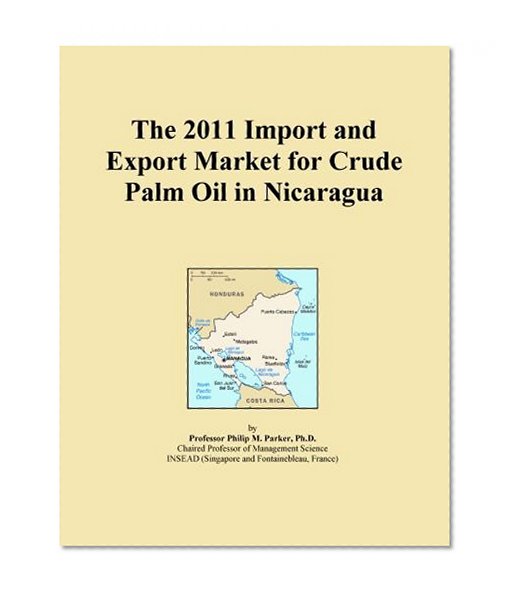


The 2011 Import and Export Market for Crude Palm Oil in Nicaragua
Book Details
Author(s)
Icon Group International
Publisher
Icon Group International
ISBN / ASIN
B004UNLRVO
ISBN-13
978B004UNLRV8
Availability
Available for download now
Sales Rank
#99,999,999
Marketplace
United States 🇺🇸
Ratings & Reviews
No reviews yet — be the first!
No reviews yet.
Description
On the demand side, exporters and strategic planners focusing on crude palm oil in Nicaragua face a number of questions. Which countries are supplying crude palm oil to Nicaragua? How important is Nicaragua compared to others in terms of the entire global and regional market? How much do the imports of crude palm oil vary from one country of origin to another in Nicaragua? On the supply side, Nicaragua also exports crude palm oil. Which countries receive the most exports from Nicaragua? How are these exports concentrated across buyers? What is the value of these exports and which countries are the largest buyers?
This report was created for strategic planners, international marketing executives and import/export managers who are concerned with the market for crude palm oil in Nicaragua. With the globalization of this market, managers can no longer be contented with a local view. Nor can managers be contented with out-of-date statistics which appear several years after the fact. I have developed a methodology, based on macroeconomic and trade models, to estimate the market for crude palm oil for those countries serving Nicaragua via exports, or supplying from Nicaragua via imports. It does so for the current year based on a variety of key historical indicators and econometric models.
In what follows, Chapter 2 begins by summarizing where Nicaragua fits into the world market for imported and exported crude palm oil. The total level of imports and exports on a worldwide basis, and those for Nicaragua in particular, is estimated using a model which aggregates across over 150 key country markets and projects these to the current year. From there, each country represents a percent of the world market. This market is served from a number of competitive countries of origin. Based on both demand- and supply-side dynamics, market shares by country of origin are then calculated across each country market destination. These shares lead to a volume of import and export values for each country and are aggregated to regional and world totals. In doing so, we are able to obtain maximum likelihood estimates of both the value of each market and the share that Nicaragua is likely to receive this year. From these figures, rankings are calculated to allow managers to prioritize Nicaragua compared to other major country markets. In this way, all the figures provided in this report are forecasts that can be combined with internal information sources for strategic planning purposes.
This report was created for strategic planners, international marketing executives and import/export managers who are concerned with the market for crude palm oil in Nicaragua. With the globalization of this market, managers can no longer be contented with a local view. Nor can managers be contented with out-of-date statistics which appear several years after the fact. I have developed a methodology, based on macroeconomic and trade models, to estimate the market for crude palm oil for those countries serving Nicaragua via exports, or supplying from Nicaragua via imports. It does so for the current year based on a variety of key historical indicators and econometric models.
In what follows, Chapter 2 begins by summarizing where Nicaragua fits into the world market for imported and exported crude palm oil. The total level of imports and exports on a worldwide basis, and those for Nicaragua in particular, is estimated using a model which aggregates across over 150 key country markets and projects these to the current year. From there, each country represents a percent of the world market. This market is served from a number of competitive countries of origin. Based on both demand- and supply-side dynamics, market shares by country of origin are then calculated across each country market destination. These shares lead to a volume of import and export values for each country and are aggregated to regional and world totals. In doing so, we are able to obtain maximum likelihood estimates of both the value of each market and the share that Nicaragua is likely to receive this year. From these figures, rankings are calculated to allow managers to prioritize Nicaragua compared to other major country markets. In this way, all the figures provided in this report are forecasts that can be combined with internal information sources for strategic planning purposes.