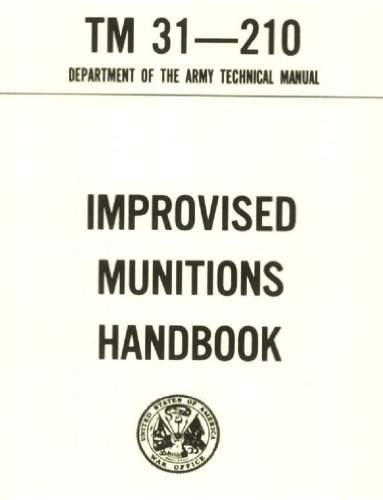


Improvised Munitions Combined with TRAINING RANGES
Book Details
ISBN / ASIN
B005ERPJO6
ISBN-13
978B005ERPJO7
Sales Rank
#2,842,471
Marketplace
United States 🇺🇸
Description
Improvised Munitions Combined with TRAINING RANGES
Take a look at the sample for this book and for details about downloading 500 free US military manuals as a thank you for taking the time to look at our book.
Purpose and Scope
In Unconventional Warfare operations it may be impossible or unwise to use conventional military munitions as tools in the conduct of certain missions. It may be necessary instead to fabricate the required munitions from locally available or unassuming materials. The purpose of this manual is to increase the potential of Special Forces and guerrilla troops by describing in detail the manufacture of munitions from seemingly innocuous locally available materials.
Manufactured, precision devices almost always will be more effective, more reliable, and easier to use than improvised ones, but shelf items will just not be available for certain operations for security or logistical reasons. Therefore the operator will have to rely on materials he can buy in a drug or paint store, find in a junk pile, or scrounge from military stocks. Also, many of the ingredients and materials used in fabricating homemade items are so commonplace or innocuous they can be carried without arousing suspicion. The completed item itself often is more easily concealed or camouflaged. In addition, the field expedient item can be tailored for the intended target, thereby providing an advantage over the standard item in flexibility and versatility.
The manual contains simple explanations and illustrations to permit construction of the items by personnel not normally familiar with making and handling munitions. These items were conceived in-house or, obtained from other publications or personnel engaged in munitions or special warfare
work. This manual includes methods for fabricating explosives, detonators, propellants, shaped charges, small arms, mortars, incendiaries, delays, switches, and similar items from indigenous materials.
Table of Contents
Section 0 — Introduction
0.1 Purpose and Scope
0.2 Safety and Reliability
0.3 User Comments
Section 1 — Explosives and Propellants (including igniters)
1.1 Plastic Explosive Filler
1.2 Potassium Nitrate
1.3 Improvised Black Powder
1.4 Nitric Acid
1.5 Initiator for Dust Explosions
1.6 Fertilizer Explosive
1.7 Carbon Tet – Explosive
1.8 Fertilizer AN-Al Explosive
1.9 “Red or White Powder†Propellant
1.10 Nitric Acid/Nitrobenzene (“Hellhoffiteâ€) Explosive
1.11 Optimized Process for Cellulose/Acid Explosives
1.12 Methyl Nitrate Dynamite
1.13 Urea Nitrate Explosive
1.14 Preparation of Copper Sulfate (Pentahydrate)
1.15 Reclamation of RDX from C4
1.16 TACC (Tetramminecopper (II) Chlorate)
1.17 HMTD
Book 2
TRAINING RANGES
PREFACE
This Book provides information about Army ranges. This book provides guidance for developing and operating Army ranges. It is a working guide for trainers, range and mobilization planners, engineers, coordinators, and mandated range project review boards at all levels of the Active Army, Army National Guard, and Army Reserve. It is the primary guide for installation and major Army command range development plans and for developing the Army Master Range Plan.
Contents
Page
Figures iii
Tables . v
Preface vii
Chapter 1. Introduction
Overview.1-1
Army Ranges .1-1
Challenge 1-2
Approaches .1-2
Planning1-2
Chapter 2. Range Modernization
The Range Modernization Program2-1
Future Outlook .2-2
Chapter 3. Training Areas and Centers
Introduction.3-1
Local Training Areas (LTA)3-1
Major Training Areas (MTA)3-1
Combat Training Centers (CTC).3-2
Training Area Functional Uses3-2
Chapter 4. Range Requirements
Introduction.4-1
Determining Training Requirements4-1
Assessing Range Needs4-2
Range Availability.4-3
Scheduling and Utilization.4-3
Quantifying Range Requirements.4-5
Throughput Capacity.4-7
Throughput Requirements4-7
Armored Vehicle Gunnery Requirements 4-8
Range Selection .4-11
Chapter 5. Range Development
Introduction.5-1
Planning5-1
Project Initiation.5-4
Take a look at the sample for this book and for details about downloading 500 free US military manuals as a thank you for taking the time to look at our book.
Purpose and Scope
In Unconventional Warfare operations it may be impossible or unwise to use conventional military munitions as tools in the conduct of certain missions. It may be necessary instead to fabricate the required munitions from locally available or unassuming materials. The purpose of this manual is to increase the potential of Special Forces and guerrilla troops by describing in detail the manufacture of munitions from seemingly innocuous locally available materials.
Manufactured, precision devices almost always will be more effective, more reliable, and easier to use than improvised ones, but shelf items will just not be available for certain operations for security or logistical reasons. Therefore the operator will have to rely on materials he can buy in a drug or paint store, find in a junk pile, or scrounge from military stocks. Also, many of the ingredients and materials used in fabricating homemade items are so commonplace or innocuous they can be carried without arousing suspicion. The completed item itself often is more easily concealed or camouflaged. In addition, the field expedient item can be tailored for the intended target, thereby providing an advantage over the standard item in flexibility and versatility.
The manual contains simple explanations and illustrations to permit construction of the items by personnel not normally familiar with making and handling munitions. These items were conceived in-house or, obtained from other publications or personnel engaged in munitions or special warfare
work. This manual includes methods for fabricating explosives, detonators, propellants, shaped charges, small arms, mortars, incendiaries, delays, switches, and similar items from indigenous materials.
Table of Contents
Section 0 — Introduction
0.1 Purpose and Scope
0.2 Safety and Reliability
0.3 User Comments
Section 1 — Explosives and Propellants (including igniters)
1.1 Plastic Explosive Filler
1.2 Potassium Nitrate
1.3 Improvised Black Powder
1.4 Nitric Acid
1.5 Initiator for Dust Explosions
1.6 Fertilizer Explosive
1.7 Carbon Tet – Explosive
1.8 Fertilizer AN-Al Explosive
1.9 “Red or White Powder†Propellant
1.10 Nitric Acid/Nitrobenzene (“Hellhoffiteâ€) Explosive
1.11 Optimized Process for Cellulose/Acid Explosives
1.12 Methyl Nitrate Dynamite
1.13 Urea Nitrate Explosive
1.14 Preparation of Copper Sulfate (Pentahydrate)
1.15 Reclamation of RDX from C4
1.16 TACC (Tetramminecopper (II) Chlorate)
1.17 HMTD
Book 2
TRAINING RANGES
PREFACE
This Book provides information about Army ranges. This book provides guidance for developing and operating Army ranges. It is a working guide for trainers, range and mobilization planners, engineers, coordinators, and mandated range project review boards at all levels of the Active Army, Army National Guard, and Army Reserve. It is the primary guide for installation and major Army command range development plans and for developing the Army Master Range Plan.
Contents
Page
Figures iii
Tables . v
Preface vii
Chapter 1. Introduction
Overview.1-1
Army Ranges .1-1
Challenge 1-2
Approaches .1-2
Planning1-2
Chapter 2. Range Modernization
The Range Modernization Program2-1
Future Outlook .2-2
Chapter 3. Training Areas and Centers
Introduction.3-1
Local Training Areas (LTA)3-1
Major Training Areas (MTA)3-1
Combat Training Centers (CTC).3-2
Training Area Functional Uses3-2
Chapter 4. Range Requirements
Introduction.4-1
Determining Training Requirements4-1
Assessing Range Needs4-2
Range Availability.4-3
Scheduling and Utilization.4-3
Quantifying Range Requirements.4-5
Throughput Capacity.4-7
Throughput Requirements4-7
Armored Vehicle Gunnery Requirements 4-8
Range Selection .4-11
Chapter 5. Range Development
Introduction.5-1
Planning5-1
Project Initiation.5-4

