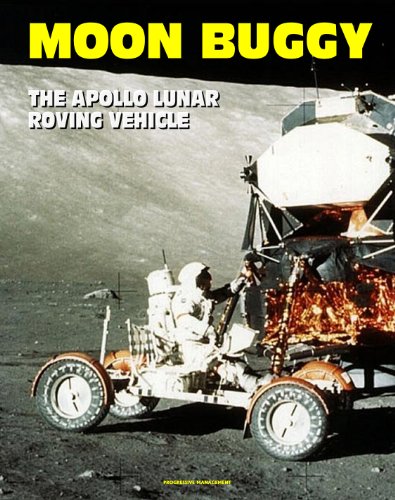


Apollo and America's Moon Landing Program: Moon Buggy, the Apollo Lunar Rover, Lunar Roving Vehicle Operations Handbook
Price not available for India
You can still browse on Amazon. Try another country above.
Book Details
Description
Incorporating the historic Lunar Roving Vehicle (LRV) Operations Handbook, this unique document provides extraordinary detail about America's Apollo Lunar Roving Vehicle (LRV), or lunar rover. Major components and systems on the incredibly successful LRV is covered in detail. It provides one of the best technical, nuts-and-bolts descriptions of the LRV available. If you are fascinated by the Apollo era, you'll want this spectacular report!
The Lunar Rover was used on the last three Apollo lunar landing missions, Apollo 15, 16, and 17 – the "J" missions. The handbook describes the LRV this way: "The LRV is a four-wheeled, self-propelled, manually controlled vehicle to be used for transporting crewmen and equipment on the lunar surface. The vehicle has accommodations for two crewmen and the stowed auxiliary equipment designed for the particular mission. The LRV system is comprised of the Mobility Subsystem, Electrical Power Subsystem, Control and Display console, Navigation Subsystem, Crew Station, Thermal Control Subsystem, and Space Support Equipment."
This handbook, prepared by the LRV contractor Boeing, provides complete information on this fantastic little "moon buggy" that made the last Apollo landings unique:
Vehicle systems, mobility subsystem, electrical power subsystem, control and display console, navigation subsystem, crew station, thermal control, space support equipment
Normal procedures: Unloading and chassis deployment, post-deployment checkout, payload loading, pre-sortie checkout, LRV configuration for science stop, display reading sequence and time intervals, special procedures, malfunction procedures, other contingencies.
Auxiliary equipment, forward chassis payload provisions, center chassis, and rear chassis.
Operating limitations – payload limitations, parking limitations, sortie limitations, navigation system, LRV and 1g trainer.
1G trainer non-crew procedures
The Lunar Rover was used on the last three Apollo lunar landing missions, Apollo 15, 16, and 17 – the "J" missions. The handbook describes the LRV this way: "The LRV is a four-wheeled, self-propelled, manually controlled vehicle to be used for transporting crewmen and equipment on the lunar surface. The vehicle has accommodations for two crewmen and the stowed auxiliary equipment designed for the particular mission. The LRV system is comprised of the Mobility Subsystem, Electrical Power Subsystem, Control and Display console, Navigation Subsystem, Crew Station, Thermal Control Subsystem, and Space Support Equipment."
This handbook, prepared by the LRV contractor Boeing, provides complete information on this fantastic little "moon buggy" that made the last Apollo landings unique:
Vehicle systems, mobility subsystem, electrical power subsystem, control and display console, navigation subsystem, crew station, thermal control, space support equipment
Normal procedures: Unloading and chassis deployment, post-deployment checkout, payload loading, pre-sortie checkout, LRV configuration for science stop, display reading sequence and time intervals, special procedures, malfunction procedures, other contingencies.
Auxiliary equipment, forward chassis payload provisions, center chassis, and rear chassis.
Operating limitations – payload limitations, parking limitations, sortie limitations, navigation system, LRV and 1g trainer.
1G trainer non-crew procedures


