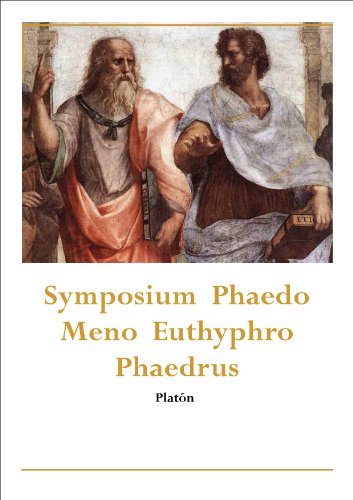


Symposium, Phaedo, Meno, Euthyphro, Phaedrus by Plato
Price not available for France
You can still browse on Amazon. Try another country above.
Book Details
Description
Plato (English pronunciation: /ˈpleɪtoÊŠ/; Greek: Πλάτων, PlátÅn, "broad";[424/423 BC[a] – 348/347 BC), was a Classical Greek philosopher, mathematician, student of Socrates, writer of philosophical dialogues, and founder of the Academy in Athens, the first institution of higher learning in the Western world. Along with his mentor, Socrates, and his student, Aristotle, Plato helped to lay the foundations of Western philosophy and science. In the famous words of A.N. Whitehead:
The safest general characterization of the European philosophical tradition is that it consists of a series of footnotes to Plato. I do not mean the systematic scheme of thought which scholars have doubtfully extracted from his writings. I allude to the wealth of general ideas scattered through them.[4]
Plato's sophistication as a writer is evident in his Socratic dialogues; thirty-six dialogues and thirteen letters have been ascribed to him. Plato's writings have been published in several fashions; this has led to several conventions regarding the naming and referencing of Plato's texts.
Plato's dialogues have been used to teach a range of subjects, including philosophy, logic, ethics, rhetoric, and mathematics.
With interactive menu.
contains:
Symposium
Phaedo
Meno
Euthyphro
Phaedrus
The safest general characterization of the European philosophical tradition is that it consists of a series of footnotes to Plato. I do not mean the systematic scheme of thought which scholars have doubtfully extracted from his writings. I allude to the wealth of general ideas scattered through them.[4]
Plato's sophistication as a writer is evident in his Socratic dialogues; thirty-six dialogues and thirteen letters have been ascribed to him. Plato's writings have been published in several fashions; this has led to several conventions regarding the naming and referencing of Plato's texts.
Plato's dialogues have been used to teach a range of subjects, including philosophy, logic, ethics, rhetoric, and mathematics.
With interactive menu.
contains:
Symposium
Phaedo
Meno
Euthyphro
Phaedrus


