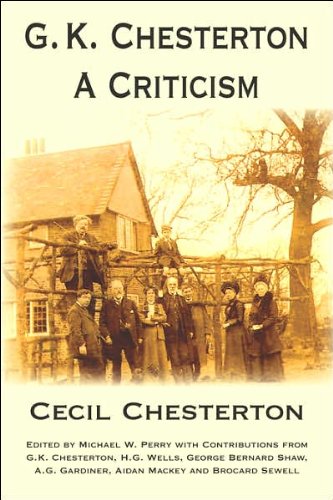


G. K. Chesterton, a Criticism
Book Details
Author(s)Cecil Chesterton
ISBN / ASINB005MDD1H4
ISBN-13978B005MDD1H6
MarketplaceCanada 🇨🇦
Description
"We are fortunate that, a century later, a flood of writings by British author G. K. Chesterton have appeared in print, (all the more as the copyrights lapse). Given how few have still read him, or heard of him, although the number grows daily, why would anyone read his brother, Cecil? Simply because readers of a hundred years ago did not know this anonymously published "Criticism" was by his brother (although they may have soon so divined). Those wishing to dip their toe, as it were, into the waters of GKC, are directed elsewhere, to the warm beaches of his fiction and mysteries, and his most accessible and inviting non-fiction, namely his riotous 1908 book with a stuffy title, "Orthodoxy".
But "A Criticism" was written just before that book slipped out to the reading public. Since Cecil was a soldier, later killed in battle, he could not write a follow-up, and this portrait is, as it were, frozen in time. The most fascinating thing about it is that Cecil takes two then well-known poems by GKC, and comparing the ideas in them, explores the changes in his brother's thinking, from, for instance, a Socialist, which is what Cecil was, to the writer of "Why I Am Not a Socialist", included here as an appendix; from an atheist to an anglo-Catholic (Church of England) to a Roman Catholic, although he did not join this last until years later in 1922; from an implicit believer in what Cecil would call "the doctrine of Progress" to someone "reacting against it".
Cecil wonders aloud what history will make of GKC; where, if anywhere, he will have a place in literature; what he will yet write, with all his road, as it were, before him. I don't agree with all of Cecil's assessments, at that time more like forecasts, when GKC was mainly known for his early poetry, the novels (or mysteries, as Cecil would tag them, "The Napoleon of Notting Hill" The Napoleon of Notting Hill (Dover Books on Literature and Drama), "The Club of Queer Trades" The Club of Queer Trades, and "The Man Who Was Thursday" The Man Who Was Thursday: A Nightmare (Annotated Edition), and continual prolific output in various papers. This would, of course, be enough to cement his reputation in the current era. But yet to come were the handful of novels that are today his most read, including "Manalive" Manalive (Hilarious Stories), "The Ball and the Cross" The Ball and the Cross, and "The Flying Inn" The Flying Inn, not to mention the Father Brown mysteries Father Brown: The Essential Tales (Modern Library Classics). And all the later non-fiction, including "Orthodoxy" Orthodoxy and "The Everlasting Man" The Everlasting Man.
That said, this book is amazingly quotable, culling any number of sparkling epigrams of GKC, and filled with lucid, ringing prose, as in his essay "The Patriotic Idea" to give one example (here cited on page 44). The other helpful source in understanding this period is GKC's own autobiography, published much later, in 1936, and here often cited by the editor The Autobiography of G.K. Chesterton. Cecil's book is not the place to first encounter GKC. But for those who already have met him it provides a fascinating journey back to the the millieu of a century ago, and helps explain why this unique and delightful writer, who in many ways stood outside of his own time, some hundred years later speaks to ours." - Amazon Reviewer
But "A Criticism" was written just before that book slipped out to the reading public. Since Cecil was a soldier, later killed in battle, he could not write a follow-up, and this portrait is, as it were, frozen in time. The most fascinating thing about it is that Cecil takes two then well-known poems by GKC, and comparing the ideas in them, explores the changes in his brother's thinking, from, for instance, a Socialist, which is what Cecil was, to the writer of "Why I Am Not a Socialist", included here as an appendix; from an atheist to an anglo-Catholic (Church of England) to a Roman Catholic, although he did not join this last until years later in 1922; from an implicit believer in what Cecil would call "the doctrine of Progress" to someone "reacting against it".
Cecil wonders aloud what history will make of GKC; where, if anywhere, he will have a place in literature; what he will yet write, with all his road, as it were, before him. I don't agree with all of Cecil's assessments, at that time more like forecasts, when GKC was mainly known for his early poetry, the novels (or mysteries, as Cecil would tag them, "The Napoleon of Notting Hill" The Napoleon of Notting Hill (Dover Books on Literature and Drama), "The Club of Queer Trades" The Club of Queer Trades, and "The Man Who Was Thursday" The Man Who Was Thursday: A Nightmare (Annotated Edition), and continual prolific output in various papers. This would, of course, be enough to cement his reputation in the current era. But yet to come were the handful of novels that are today his most read, including "Manalive" Manalive (Hilarious Stories), "The Ball and the Cross" The Ball and the Cross, and "The Flying Inn" The Flying Inn, not to mention the Father Brown mysteries Father Brown: The Essential Tales (Modern Library Classics). And all the later non-fiction, including "Orthodoxy" Orthodoxy and "The Everlasting Man" The Everlasting Man.
That said, this book is amazingly quotable, culling any number of sparkling epigrams of GKC, and filled with lucid, ringing prose, as in his essay "The Patriotic Idea" to give one example (here cited on page 44). The other helpful source in understanding this period is GKC's own autobiography, published much later, in 1936, and here often cited by the editor The Autobiography of G.K. Chesterton. Cecil's book is not the place to first encounter GKC. But for those who already have met him it provides a fascinating journey back to the the millieu of a century ago, and helps explain why this unique and delightful writer, who in many ways stood outside of his own time, some hundred years later speaks to ours." - Amazon Reviewer
More Books by Cecil Chesterton



