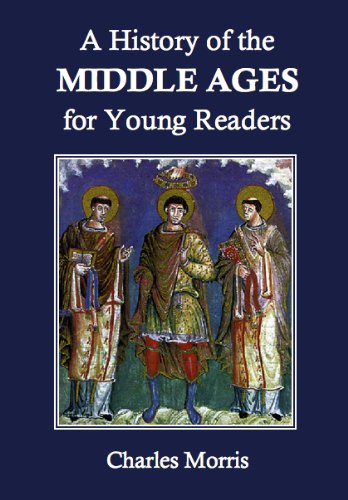


A History of the Middle Ages for Young Readers
Price not available for India
You can still browse on Amazon. Try another country above.
Book Details
Author(s)
Charles Morris
Publisher
A. J. Cornell Publications
ISBN / ASIN
B005MU9PI6
ISBN-13
978B005MU9PI0
Marketplace
India 🇮🇳
Ratings & Reviews
No reviews yet — be the first!
No reviews yet.
Description
Originally published in 1904 as a portion of the author’s larger “History of the World,†this Kindle edition, equivalent in length to a physical book of approximately 120 pages, recounts, in simple language for young readers, the history of the Middle Ages (including the Dark Ages)—approximately from the fall of the Roman Empire (fifth century) to the fall of Constantinople (1453).
CONTENTS
Part I: The Dark Ages
Introduction
I: The Invasions of the Teutons
II The Persian and Eastern Empires
III: The Empire of the Saracens
IV: The Empire of Charlemagne
V: The Popes and Their Influence
VI: Feudalism and Chivalry
VII: The Era of the Crusades
Part II: The Revival of Civilization
VIII: Medieval Progress
IX: England in Medieval Times
X: France and Spain
XI: Germany and Italy
XII: The Elements of Medieval Progress
Part III: Timeline of Medieval History
Sample passage:
When the eighth century neared its end, the continent of Europe was not at all like what we find it today. In place of the present kingdoms and empires, there was nothing fixed and stable. In the east was the little that was left of the old Roman Empire, a weak and sickly sort of government. Italy was held by the Lombards in the north, while the emperors at Constantinople still ruled over the south. Spain had been conquered from the Goths and was part of the empire of the Saracens. As for France, it had not yet become a distinct kingdom, for its rulers were Germans, and there was little separation between France and Germany. But near the middle of the century there was born a man who was to make a remarkable change in European affairs.
Three great men came in succession, Charles Martel, the Mayor of the Palace, who won the great victory at Tours; his son, Pepin the Short, who took the crown from the feeble King of the Franks, and his grandson Charles, who has since been known as Charlemagne, or Charles the Great, and who was one of the most famous monarchs of history.
Charles was born in 742, and became king when his father died in 768. His brother Carloman ruled with him for a time, but he soon died and left Charles as sole king. This great monarch reigned for nearly half a century, and his reign was so full of wars and conquests that at his death he ruled over a great part of western Europe. He made no less than fifty-two military campaigns, nearly all of them successful, and he proved himself as great a statesman as he was a soldier.
About the author:
Charles Morris (1833-1922) was the author of numerous books for young and old, including “The Lives of the Presidents and How They Reached the White House,†“Tales from the Dramatists,†and “Primary History of the United States.â€
CONTENTS
Part I: The Dark Ages
Introduction
I: The Invasions of the Teutons
II The Persian and Eastern Empires
III: The Empire of the Saracens
IV: The Empire of Charlemagne
V: The Popes and Their Influence
VI: Feudalism and Chivalry
VII: The Era of the Crusades
Part II: The Revival of Civilization
VIII: Medieval Progress
IX: England in Medieval Times
X: France and Spain
XI: Germany and Italy
XII: The Elements of Medieval Progress
Part III: Timeline of Medieval History
Sample passage:
When the eighth century neared its end, the continent of Europe was not at all like what we find it today. In place of the present kingdoms and empires, there was nothing fixed and stable. In the east was the little that was left of the old Roman Empire, a weak and sickly sort of government. Italy was held by the Lombards in the north, while the emperors at Constantinople still ruled over the south. Spain had been conquered from the Goths and was part of the empire of the Saracens. As for France, it had not yet become a distinct kingdom, for its rulers were Germans, and there was little separation between France and Germany. But near the middle of the century there was born a man who was to make a remarkable change in European affairs.
Three great men came in succession, Charles Martel, the Mayor of the Palace, who won the great victory at Tours; his son, Pepin the Short, who took the crown from the feeble King of the Franks, and his grandson Charles, who has since been known as Charlemagne, or Charles the Great, and who was one of the most famous monarchs of history.
Charles was born in 742, and became king when his father died in 768. His brother Carloman ruled with him for a time, but he soon died and left Charles as sole king. This great monarch reigned for nearly half a century, and his reign was so full of wars and conquests that at his death he ruled over a great part of western Europe. He made no less than fifty-two military campaigns, nearly all of them successful, and he proved himself as great a statesman as he was a soldier.
About the author:
Charles Morris (1833-1922) was the author of numerous books for young and old, including “The Lives of the Presidents and How They Reached the White House,†“Tales from the Dramatists,†and “Primary History of the United States.â€


