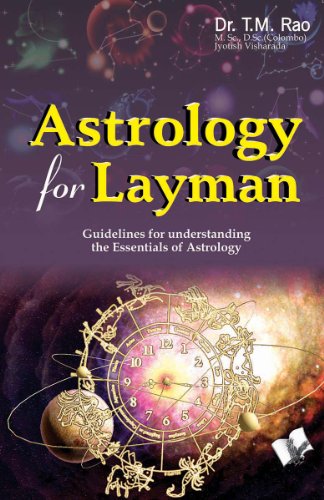


Astrology For Layman
Price not available for United Kingdom
You can still browse on Amazon. Try another country above.
Book Details
Author(s)
Dr. T.M. Rao
Publisher
V&S Publishers
ISBN / ASIN
B005S65OW0
ISBN-13
978B005S65OW6
Marketplace
United Kingdom 🇬🇧
Ratings & Reviews
No reviews yet — be the first!
No reviews yet.
Description
Astrology nowadays is universally recognised as a science, based on sound mathematical principles and calculations.
But while it is easy to agree to this premise, it is difficult to find a well-researched comprehensive book to guide the general reader.
In response to this need,this book is designed to bring home to the reader the fundamentals of the discipline with the predictive aspect.
One who reads this book, will not only be able to make fairly correct predictions but also will be encouraged to take to the study of more advanced works.
The book is a complete astrology guide that begins with the fundamental principles bringing you a wealth fo information offering-
*How 12 Rasis have been formulated, and goes on to explain the method of casting a horoscope.
*What are the qualities ascribed to people born under different signs( for instance, people born under Aries are of independent nature).
*What is the meaning of Bhavas (viz., what a planet indicates in a specific house).
*What do the Mahadasas of different planets mean?
*What are Yogas (for instance Sakaka Yoga makes a person stubborn and hated by relatives and Parvata Yoga makes a person passionate).
The book also offers a special section on the subjects of matrimony, compatibility along with case studies predicting major events of your life like career-change, gain or loss of fortune etc.
The book remains one of the most authoritative guides on astrology, written by a leading authority. Your search for the best book available on the subject must end here.
About the author:
Dr. T.M. Rao (Turaga Madhusudhana Rao) was born on 3rd July 1927 at Guntur in Andhra Pradesh. He did his B.Sc (Hons) and M.Sc (Research) from the Andhra University at Waltair.
He joined the Geological Survey of India as a Gazetted Officer in 1948 and retired as Director in 1985.
Though he had keen interest in Astrology, he could not pursue this, and could do so only after retirement in 1985. He started his professional consultations in 1987 in Hyderabad.
Later he developed interest in Medical Astrology and began offering advice in 1997 to the different Corporate Hospitals of Hyderabad with regard to various problems quite successfully.
The Open International University for Complementary Medicine, Colombo has conferred upon himD.Sc in November,1997.
He is also a recipient of several titles from different Astrological Associations and organisations as well.
He has also authored a book entitled Marriage-Matching Astrologically published by Pustak Mahal, Delhi, which has received wide appreciation from all over India.
Contents:
1.General Principles
2.Planets Characteristics
3.Casting of Lagna and Other Details
4.Planetary Strength
5.Span of Life
6.Rasi Effects
7.On Bhavas
8.Planets and Signs
9.The Position of Bhavadhipathis in Houses
10.Some Important Points
11.Dasa Periods
12.Yogas
13.Issue
14.Matrimony
15.Female Horoscope
16.Health and Planets
17.Profession
18.Gochara (Transit)
19.Hora
20.Death
21.Muhurta or Election
22.Prayers
23.Birth Star Significance
24.Hindu Time Measure
Conclusion
References
But while it is easy to agree to this premise, it is difficult to find a well-researched comprehensive book to guide the general reader.
In response to this need,this book is designed to bring home to the reader the fundamentals of the discipline with the predictive aspect.
One who reads this book, will not only be able to make fairly correct predictions but also will be encouraged to take to the study of more advanced works.
The book is a complete astrology guide that begins with the fundamental principles bringing you a wealth fo information offering-
*How 12 Rasis have been formulated, and goes on to explain the method of casting a horoscope.
*What are the qualities ascribed to people born under different signs( for instance, people born under Aries are of independent nature).
*What is the meaning of Bhavas (viz., what a planet indicates in a specific house).
*What do the Mahadasas of different planets mean?
*What are Yogas (for instance Sakaka Yoga makes a person stubborn and hated by relatives and Parvata Yoga makes a person passionate).
The book also offers a special section on the subjects of matrimony, compatibility along with case studies predicting major events of your life like career-change, gain or loss of fortune etc.
The book remains one of the most authoritative guides on astrology, written by a leading authority. Your search for the best book available on the subject must end here.
About the author:
Dr. T.M. Rao (Turaga Madhusudhana Rao) was born on 3rd July 1927 at Guntur in Andhra Pradesh. He did his B.Sc (Hons) and M.Sc (Research) from the Andhra University at Waltair.
He joined the Geological Survey of India as a Gazetted Officer in 1948 and retired as Director in 1985.
Though he had keen interest in Astrology, he could not pursue this, and could do so only after retirement in 1985. He started his professional consultations in 1987 in Hyderabad.
Later he developed interest in Medical Astrology and began offering advice in 1997 to the different Corporate Hospitals of Hyderabad with regard to various problems quite successfully.
The Open International University for Complementary Medicine, Colombo has conferred upon himD.Sc in November,1997.
He is also a recipient of several titles from different Astrological Associations and organisations as well.
He has also authored a book entitled Marriage-Matching Astrologically published by Pustak Mahal, Delhi, which has received wide appreciation from all over India.
Contents:
1.General Principles
2.Planets Characteristics
3.Casting of Lagna and Other Details
4.Planetary Strength
5.Span of Life
6.Rasi Effects
7.On Bhavas
8.Planets and Signs
9.The Position of Bhavadhipathis in Houses
10.Some Important Points
11.Dasa Periods
12.Yogas
13.Issue
14.Matrimony
15.Female Horoscope
16.Health and Planets
17.Profession
18.Gochara (Transit)
19.Hora
20.Death
21.Muhurta or Election
22.Prayers
23.Birth Star Significance
24.Hindu Time Measure
Conclusion
References

