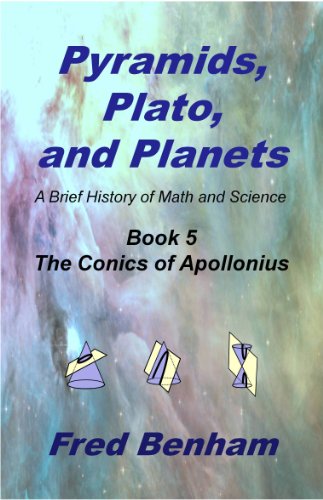


The Conics of Apollonius (Pyramids, Plato, and Planets Book 5)
Book Details
Author(s)
Fred Benham
Publisher
Fred Benham
ISBN / ASIN
B007CM5ZK4
ISBN-13
978B007CM5ZK0
Sales Rank
#417,282
Marketplace
United States 🇺🇸
Description
The Conics of Apollonius is book five in a series of nine books covering the history of math and science. The series is intended to bridge the gap between the too general and the too detailed. It is intended for the general audience but also it contains sufficient information so that it can be used as a top level textbook. Numerous illustrations are presented to help guide the reader through each topic. The illustrations have all been formatted such that they are clearly legible on smaller handheld displays such as the 3.6 x 4.8 inch Kindle display.
Since “mathematics is the language of scienceâ€, some algebraic formulas are presented where appropriate (a short algebra refresher is contained in the appendix); however, the material should be of general interest even if the mathematics is bypassed. Also, since so much of math and science were developed over the centuries, the information is provided within the context of an historical timeline.
The term “conics†refers to the intersection of a plane with a cone. The intersections form curves which Apollonius named the ellipse, parabola, and hyperbola. The intent of this book is to provide an overview of the conics using a selected subset of the propositions developed by Apollonius, interspersed with practical examples of their usage. The propositions were used by both Kepler and Newton when they developed the laws of planetary motion.
Since “mathematics is the language of scienceâ€, some algebraic formulas are presented where appropriate (a short algebra refresher is contained in the appendix); however, the material should be of general interest even if the mathematics is bypassed. Also, since so much of math and science were developed over the centuries, the information is provided within the context of an historical timeline.
The term “conics†refers to the intersection of a plane with a cone. The intersections form curves which Apollonius named the ellipse, parabola, and hyperbola. The intent of this book is to provide an overview of the conics using a selected subset of the propositions developed by Apollonius, interspersed with practical examples of their usage. The propositions were used by both Kepler and Newton when they developed the laws of planetary motion.

