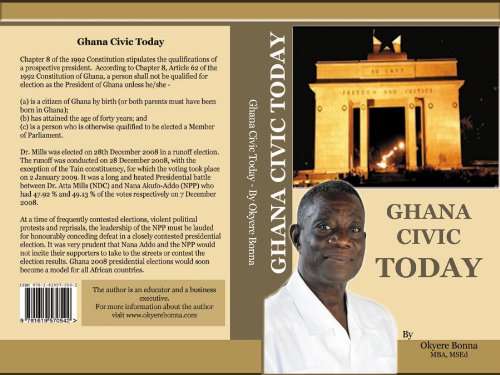


GHANA CIVIC TODAY
Book Details
Author(s)
Okyere Bonna
ISBN / ASIN
B007FDCYMC
ISBN-13
978B007FDCYM5
Sales Rank
#1,784,617
Marketplace
United States 🇺🇸
Ratings & Reviews
No reviews yet — be the first!
No reviews yet.
Description
In December 2008 Ghana bécame the trailblazer of a peaceful transition of power in Africa.
It is not unusual to find violence in closely contested presidential elections in Africa. Political violence in Africa [in the main], is an expression of resistance to an imposition of a candidate on the people through election or the power of the gun. Political violence in Africa is a reaction to what citizens see as electoral fraud or stealing of their mandate and voice. Usually the incumbent regime rigs election and imposes itself on the will of the people. The popular revolution sweeping across North Africa and the Middle East is an open display of the popular opposition against the situation where presidents rule for life.
Unfortunately in many parts of Africa the rule of law is often diluted, and orderly succession is difficult to achieve hence many states are either engaged in or are emerging from war. According to Post Election Violence report, elections-related violence is typically systemic and is often an indicator of challenges faced in terms of economic development, nation-building and the consolidation of political power. The report goes on to say that “given that most African states have weak institutions, this process is easily inflamed.â€
Ghana’s 2008 presidential election was unprecedented in the history of Africa, where an incumbent regime that has come so close to winning an election with a 49.7% in a multi-party contest of eight contestants/ candidates would not claim automatic victory but allow for a runoff and eventually cocede defeat to the opposition party. International and local election observers said the 2008 Ghana election was fair and peaceful, and there were no major breaches in voting and no major incidences of violence.
In 2010 some 22 African countries who would go to the polls would have Ghana in mind and most of them would witness a peaceful transfer of power. Thanks to Ghana Electoral Commission (that conducted the Ghana’s 2008 presidential election) the precedence has been laid for future peaceful presidential elections in Africa.
In this book the autor gives a vivid picture of the election process and power struggle in Africa and argues that Ghana’s peaceful transition of power, amidst the political violence in the región have (and would continue to) set the pace for peaceful elections and trasition of power in Africa.
It is not unusual to find violence in closely contested presidential elections in Africa. Political violence in Africa [in the main], is an expression of resistance to an imposition of a candidate on the people through election or the power of the gun. Political violence in Africa is a reaction to what citizens see as electoral fraud or stealing of their mandate and voice. Usually the incumbent regime rigs election and imposes itself on the will of the people. The popular revolution sweeping across North Africa and the Middle East is an open display of the popular opposition against the situation where presidents rule for life.
Unfortunately in many parts of Africa the rule of law is often diluted, and orderly succession is difficult to achieve hence many states are either engaged in or are emerging from war. According to Post Election Violence report, elections-related violence is typically systemic and is often an indicator of challenges faced in terms of economic development, nation-building and the consolidation of political power. The report goes on to say that “given that most African states have weak institutions, this process is easily inflamed.â€
Ghana’s 2008 presidential election was unprecedented in the history of Africa, where an incumbent regime that has come so close to winning an election with a 49.7% in a multi-party contest of eight contestants/ candidates would not claim automatic victory but allow for a runoff and eventually cocede defeat to the opposition party. International and local election observers said the 2008 Ghana election was fair and peaceful, and there were no major breaches in voting and no major incidences of violence.
In 2010 some 22 African countries who would go to the polls would have Ghana in mind and most of them would witness a peaceful transfer of power. Thanks to Ghana Electoral Commission (that conducted the Ghana’s 2008 presidential election) the precedence has been laid for future peaceful presidential elections in Africa.
In this book the autor gives a vivid picture of the election process and power struggle in Africa and argues that Ghana’s peaceful transition of power, amidst the political violence in the región have (and would continue to) set the pace for peaceful elections and trasition of power in Africa.


![Who is Barack Obama? [Russian Translation]](https://www.ebooknetworking.net/books/B00/EZS/medB00EZSXWUI.jpg)


