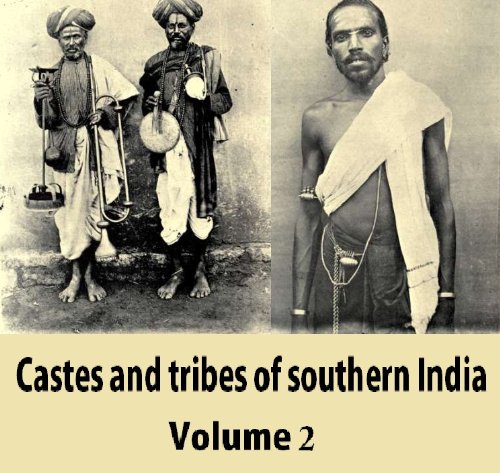


Castes and tribes of southern India, Volume 2
Book Details
Author(s)Edgar Thurston
ISBN / ASINB007P73QZC
ISBN-13978B007P73QZ9
MarketplaceFrance 🇫🇷
Description
The majority of Chakkiliyans are not tanners, but leather-workers, and, instead of getting the hides or skins direct from the Vettiyan, they prefer to purchase them ready-tanned from traders, who bring them from the large tanning centres. When the Chuckler starts making shoes or sandals, he purchases the leather and skin which he requires in the bazar, and, taking it home, first proceeds with a preliminary currying operation. The leather is damped and well stretched, and dyed with aniline, the usual colour being scarlet R.R. of the Badische Anilin Soda Fabrik. This is purchased in the bazar in packets, and is dissolved in water, to which a little oxalic acid has been added. The dye is applied with a piece of rag on the grain side, and allowed to dry. After drying, tamarind paste is applied to the flesh side of the skin, and the latter is then rolled between the hands, so as to produce a coarse graining on the outer side. In making the shoes, the leather is usually wetted, and moulded into shape on wooden moulds or lasts. As a rule, nothing but cotton is used for sewing, and the waxed ends of the English cobler are entirely unknown. The largest consumption of leather in this Presidency is for water-bags or kavalais, which are used for raising water from wells, and for oil and ghee (clarified butter) pots, in which the liquids are transported from one place to another. Of irrigation wells there are in the Presidency more than 600,000, and, though some of them are fitted with iron buckets, nearly all of them have leather bags with leather discharging trunks. The buckets hold from ten to fifty gallons of water, and are generally made from fairly well tanned cow hides, though for very large buckets buffalo hides are sometimes used. The number of oil and ghee pots in use in the country is very large.
The use of leather vessels for this purpose is on the decline, as it is found much cheaper and more convenient to store oil in the ubiquitous kerosine-oil tin, and it is not improbable that eventually the industry will die out, as it has done in other countries. The range of work of the country Chuckler is not very extensive. Besides leather straps for wooden sandals, he makes crude harness for the ryot's cattle, including leather collars from which numerous bells are frequently suspended, leather whips for the cattle drivers, ornamental fringes for the bull's forehead, bellows for the smith, and small boxes for the barber, in which to carry his razors. In some places, leather ropes are used for various purposes, and it is customary to attach big coir (cocoanut fibre) ropes to the bodies of the larger temple cars by leather harness, when they are drawn in procession through the streets. Drum-heads and tom-toms are made from raw hides by Vettiyans and Chucklers. The drums are often very large, and are transported upon the back of elephants, horses, bulls and camels. For them raw hides are required, but for the smaller instruments sheep-skins are sufficient. The raw hides are shaved on the flesh side, and are then dried. The hair is removed by rubbing with wood-ashes. The use of lime in unhairing is not permissible, as it materially decreases the elasticity of the parchment." The Chakkiliyans beat the tom-tom for Kammalans, Pallis and Kaikolans, and for other castes if desired to do so.
The Chakkiliyans do not worship Matangi, who is the special deity of the Madigas. Their gods include Madurai Viran, Mariamma, Muneswara, Draupadi and Gangamma. Of these, the last is the most important, and her festival is celebrated annually, if possible. To cover the expenses thereof, a few Chakkiliyans dress up
so as to represent men and women of the Marathi bird-catching caste, and go about begging in the streets for nine days. On the tenth day the festival terminates. Throughout it, Gangamma, represented by three decorated pots under a small pandal (booth) set up on the bank of a river or tank beneath a margosa (Melia azadirachta), or pipal ...
The use of leather vessels for this purpose is on the decline, as it is found much cheaper and more convenient to store oil in the ubiquitous kerosine-oil tin, and it is not improbable that eventually the industry will die out, as it has done in other countries. The range of work of the country Chuckler is not very extensive. Besides leather straps for wooden sandals, he makes crude harness for the ryot's cattle, including leather collars from which numerous bells are frequently suspended, leather whips for the cattle drivers, ornamental fringes for the bull's forehead, bellows for the smith, and small boxes for the barber, in which to carry his razors. In some places, leather ropes are used for various purposes, and it is customary to attach big coir (cocoanut fibre) ropes to the bodies of the larger temple cars by leather harness, when they are drawn in procession through the streets. Drum-heads and tom-toms are made from raw hides by Vettiyans and Chucklers. The drums are often very large, and are transported upon the back of elephants, horses, bulls and camels. For them raw hides are required, but for the smaller instruments sheep-skins are sufficient. The raw hides are shaved on the flesh side, and are then dried. The hair is removed by rubbing with wood-ashes. The use of lime in unhairing is not permissible, as it materially decreases the elasticity of the parchment." The Chakkiliyans beat the tom-tom for Kammalans, Pallis and Kaikolans, and for other castes if desired to do so.
The Chakkiliyans do not worship Matangi, who is the special deity of the Madigas. Their gods include Madurai Viran, Mariamma, Muneswara, Draupadi and Gangamma. Of these, the last is the most important, and her festival is celebrated annually, if possible. To cover the expenses thereof, a few Chakkiliyans dress up
so as to represent men and women of the Marathi bird-catching caste, and go about begging in the streets for nine days. On the tenth day the festival terminates. Throughout it, Gangamma, represented by three decorated pots under a small pandal (booth) set up on the bank of a river or tank beneath a margosa (Melia azadirachta), or pipal ...
More Books by Edgar Thurston

![Ethnographic Notes in Southern India: With 40 Plates [1906]](https://www.ebooknetworking.net/books/111/260/med1112604472.jpg)


