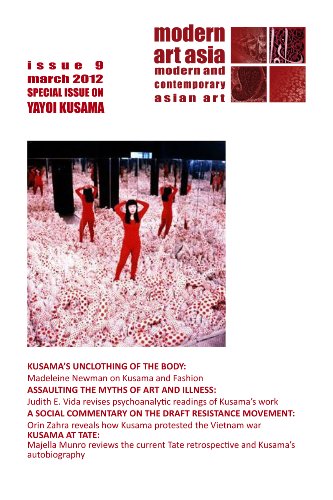


Modern Art Asia Issue 9: Yayoi Kusama
Book Details
PublisherEnzo Arts and Publishing Limited
ISBN / ASINB007TO43Q2
ISBN-13978B007TO43Q0
MarketplaceGermany 🇩🇪
Description
To coincide with the opening of a major Yayoi Kusama exhibit at Tate Modern - her first retrospective in the UK - and the translation of her autobiography, Infinity Net, into English, this issue presents three research papers offering new perspectives on the life and practice of this internationally regarded Japanese artist.
Kusama is perhaps best known for her consistent revisitation of set iconographies throughout her career: the soft phallic sculpture, the pumpkin, the polka dot. The latter, most usually a white dot on a red ground, an inversion of the chauvanism inherent in the Japanese flag, reveals much about Kusama's fierce stance against hegemony, militarism, and sexual intolerance.
Orin Zahra examines the activist and pacifist elements of Kusama's work further, through her consideration of Kusama's radical street performances and happenings within the nexus of anti-Vietnam protest in sixties America, where Kusama resided at that time. Judith E. Vida presents a psychoanalytically-informed account of Kusama's practice, using her work as a case study in the psychic and emphatetic processes demanded by the reception of art. Madeleine Newman concentrates on Kusama's experiments with fashion, and her creation of an avant-garde sartorial idiom that defied convention and explored the limits of subjectivity. Majella Munro gives an account of the new Tate show and a review of Kusama's autobiography, interrogating how the narratives of each are complementary and, at times, problematic. We conclude with our reviews section by Amy Jane Barnes.
Kusama is perhaps best known for her consistent revisitation of set iconographies throughout her career: the soft phallic sculpture, the pumpkin, the polka dot. The latter, most usually a white dot on a red ground, an inversion of the chauvanism inherent in the Japanese flag, reveals much about Kusama's fierce stance against hegemony, militarism, and sexual intolerance.
Orin Zahra examines the activist and pacifist elements of Kusama's work further, through her consideration of Kusama's radical street performances and happenings within the nexus of anti-Vietnam protest in sixties America, where Kusama resided at that time. Judith E. Vida presents a psychoanalytically-informed account of Kusama's practice, using her work as a case study in the psychic and emphatetic processes demanded by the reception of art. Madeleine Newman concentrates on Kusama's experiments with fashion, and her creation of an avant-garde sartorial idiom that defied convention and explored the limits of subjectivity. Majella Munro gives an account of the new Tate show and a review of Kusama's autobiography, interrogating how the narratives of each are complementary and, at times, problematic. We conclude with our reviews section by Amy Jane Barnes.
