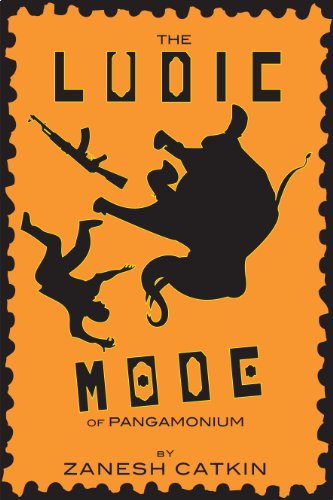


The Ludic Mode of Pangamonium
Book Details
Author(s)
Zanesh Catkin
Publisher
MidnightSun Publishing
ISBN / ASIN
B008PRDWSW
ISBN-13
978B008PRDWS4
Sales Rank
#2,850,699
Marketplace
United States 🇺🇸
Description
A thesis in Creative Writing has two components: a novel and an exegesis.
Pangamonium is a comic novel that parodies and satirises adventure romances and travel accounts as well as global imperialisms. Francis, an American journalist who has lived in Australia, travels to a tiny Asian country, Panga, a kingdom that has been taken over by a military dictatorship. There he meets Easter, an African on a quest to find the grave and buried treasure of his pirate ancestor. The odd couple endure a comic odyssey together and ultimately liberate a group of enslaved children from a vibrator factory.
The Ludic Mode of Pangamonium is an exegesis of the novel. It explores the ludic mode, which it considers an open play of signification characterised by freedom, reflexivity and subversion, and it explores the work of Nabokov, Calvino and Borges to explicate manifestations of play. Pangamonium is also examined in the light of its mythic hero quest structure and its relationship to the discourses of Orientalism and Neocolonialism.
“Its focuses, approaches, strategies, language, understandings, probings, argumentation and relevance to/enhancement of its accompanying creative product…are all outstanding.
This is a strong piece of academic research.
It clearly displays original and critical thought, by bringing together critical discourses about disparate literary genres – the ludic novel, the quest narrative, the travel piece, the adventure romance, the postcolonial novel, the satire, etc – and places them in the context of a new work of fiction which is itself a delightful application of refreshed and traditional thinking about the novel form.
It provides a significant contribution to knowledge in that it delves deeply into several genre areas – especially the ludic novel – and produces a strong academic discussion, which is also a perceptive writerly account, of the thinking behind writing in a global context. The submission examines the white Anglo-Saxon male writer confronting surrounding cultural perspectives with a rare viewpoint that trades off (and identifies with) North American, Australian and other cultural perspectives.
It relates the topic of research to the broader framework of the discipline within which it falls, by actively entering the literary and philosophical discussions underlying it, and by choosing to focus discussion on major novelists, critics and commentators in the field, and their relevant major works, and it is clearly, accurately and cogently written, suitably illustrated with examples to support an argument which builds in significance from start to finish.
…an excellent example of an exegesis…outstanding…”
Pangamonium is a comic novel that parodies and satirises adventure romances and travel accounts as well as global imperialisms. Francis, an American journalist who has lived in Australia, travels to a tiny Asian country, Panga, a kingdom that has been taken over by a military dictatorship. There he meets Easter, an African on a quest to find the grave and buried treasure of his pirate ancestor. The odd couple endure a comic odyssey together and ultimately liberate a group of enslaved children from a vibrator factory.
The Ludic Mode of Pangamonium is an exegesis of the novel. It explores the ludic mode, which it considers an open play of signification characterised by freedom, reflexivity and subversion, and it explores the work of Nabokov, Calvino and Borges to explicate manifestations of play. Pangamonium is also examined in the light of its mythic hero quest structure and its relationship to the discourses of Orientalism and Neocolonialism.
“Its focuses, approaches, strategies, language, understandings, probings, argumentation and relevance to/enhancement of its accompanying creative product…are all outstanding.
This is a strong piece of academic research.
It clearly displays original and critical thought, by bringing together critical discourses about disparate literary genres – the ludic novel, the quest narrative, the travel piece, the adventure romance, the postcolonial novel, the satire, etc – and places them in the context of a new work of fiction which is itself a delightful application of refreshed and traditional thinking about the novel form.
It provides a significant contribution to knowledge in that it delves deeply into several genre areas – especially the ludic novel – and produces a strong academic discussion, which is also a perceptive writerly account, of the thinking behind writing in a global context. The submission examines the white Anglo-Saxon male writer confronting surrounding cultural perspectives with a rare viewpoint that trades off (and identifies with) North American, Australian and other cultural perspectives.
It relates the topic of research to the broader framework of the discipline within which it falls, by actively entering the literary and philosophical discussions underlying it, and by choosing to focus discussion on major novelists, critics and commentators in the field, and their relevant major works, and it is clearly, accurately and cogently written, suitably illustrated with examples to support an argument which builds in significance from start to finish.
…an excellent example of an exegesis…outstanding…”

