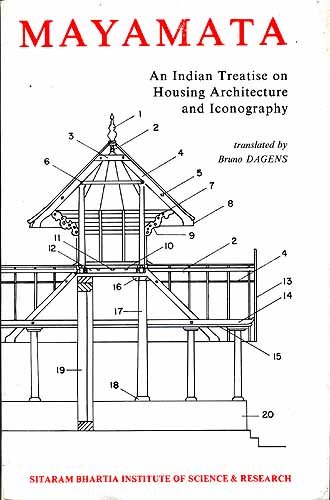
MAYAMATA : An Indian Treatise on Housing Architecture and Iconography
Description
Language: English
Pages: 309
About the Book
The MAYAMATA is a Vastusastra, that is to say a 'treatise on dwelling' and, as such, it deals with all the facets of gods' and men's dwellings, from the choice of a site to the iconography of temple walls. It contains numerous and precise descriptions of villages and towns as well as of temples, houses, mansions and palaces. It gives indications for the selection of a proper orientation, of right dimensions and of appropriate building materials. It intends to be a manual for the architect and a guide-book for the layman. Well-thought-of by the traditional architects (sthapati-s) of South India, this treatise is of interest at a time when technical traditions, in all fields are being scrutinized for their possible modern application.
The MAYAMATA has so far been translated into Tamil and into French. The present English version is based upon the Edition, with French translation, previously published by Dr. B. Dagens in the Publication Series of the French Institute of Indology (Pondicherry).
About the Author
Dr. Bruno DAGENS (b. 1935) is a member of the Ecole Francaise d' Extreme-Orient (French School for Far Eastern Studies). He has done archaeological researches in Afghanistan and in Cambodia and taught Sanskrit at the University of Louvain (Belgium). Since 1977 he has been working at the Institut Francais d' Indologie at Pondicherry.
Besides articles and contributions on archaeology and on iconography of monuments in Afghanistan and in Cambodia, he has published critical editions and French translations of the Mayamata and of the Saivagamaparibhasamanjari (a compendium of Saiva doctrine and rituals) and a study on architecture in Saivagama-s. His most recent book is a two volume survey of the monuments of the submerged area of Srisailam (Andhra Pradesh) .
Pages: 309
About the Book
The MAYAMATA is a Vastusastra, that is to say a 'treatise on dwelling' and, as such, it deals with all the facets of gods' and men's dwellings, from the choice of a site to the iconography of temple walls. It contains numerous and precise descriptions of villages and towns as well as of temples, houses, mansions and palaces. It gives indications for the selection of a proper orientation, of right dimensions and of appropriate building materials. It intends to be a manual for the architect and a guide-book for the layman. Well-thought-of by the traditional architects (sthapati-s) of South India, this treatise is of interest at a time when technical traditions, in all fields are being scrutinized for their possible modern application.
The MAYAMATA has so far been translated into Tamil and into French. The present English version is based upon the Edition, with French translation, previously published by Dr. B. Dagens in the Publication Series of the French Institute of Indology (Pondicherry).
About the Author
Dr. Bruno DAGENS (b. 1935) is a member of the Ecole Francaise d' Extreme-Orient (French School for Far Eastern Studies). He has done archaeological researches in Afghanistan and in Cambodia and taught Sanskrit at the University of Louvain (Belgium). Since 1977 he has been working at the Institut Francais d' Indologie at Pondicherry.
Besides articles and contributions on archaeology and on iconography of monuments in Afghanistan and in Cambodia, he has published critical editions and French translations of the Mayamata and of the Saivagamaparibhasamanjari (a compendium of Saiva doctrine and rituals) and a study on architecture in Saivagama-s. His most recent book is a two volume survey of the monuments of the submerged area of Srisailam (Andhra Pradesh) .