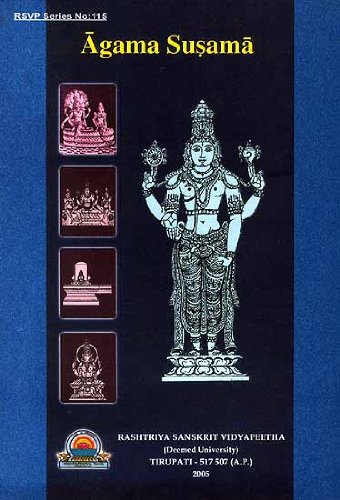


Agama Susama (Glimpses of the National Seminar on Agamas)
Currently unavailable.
Book Details
ISBN / ASINB008RYCB80
ISBN-13978B008RYCB80
AvailabilityCurrently unavailable.
MarketplaceUnited States 🇺🇸
Description
Pages: 276
Foreword
Agamas are known to be the reservoir of knowledge an Upasana as an important component of
Sadhana Marga. They are believed to provide a synthesis of Karma Marga and Jnana Marga.
Agamas have also become the main source-material on what may be described as Temple Culture,
- which consists of themes, such as, the principles of Temple construction, rules and norms
for installation of the Idol in the garbhagriha of the Temple, methods, techniques and
modalities of worship, including the rules and norms for conduct of rituals, special Utsavas
etc. and various Tantras aimed at realization of specific phalas. The etymological meaning
of Agama signifies that Agama Sastra is a compendium of Dharma and Adharma and it provides
useful guidelines for purusing Dharma Marga in practical life.
Agamas are highly diversified in terms of their basic tenets and practices. We have
Vaisnava Agamas, Saiva Agamas and Sakta Agamas. Even in the Vaisnava tradition, we have two
main streams of approaches viz Pancaratra Agama and Vaikhanasa Agama.
Different forms of Upasana Kramas are conceived and prescribed in Agama Sastra. Sri
Madhvacharya, provides an interesting rationale for these different categories of Upasana
karmas. While commenting on the Brahma Sutra.
In his Brahma Sutra Bhasya, Acharya states as follows :
Thus, the variance in Upasanas is due to the differences in the of different
Upasakas. The modality of doing Upasana through the idols of the Lord, pertains to those who
are not fully accompalished with true knowledge. We all belong to the category of and hence
worship of the deity in the form of Idols is prescribed.
It is asserted in the Aga
Foreword
Agamas are known to be the reservoir of knowledge an Upasana as an important component of
Sadhana Marga. They are believed to provide a synthesis of Karma Marga and Jnana Marga.
Agamas have also become the main source-material on what may be described as Temple Culture,
- which consists of themes, such as, the principles of Temple construction, rules and norms
for installation of the Idol in the garbhagriha of the Temple, methods, techniques and
modalities of worship, including the rules and norms for conduct of rituals, special Utsavas
etc. and various Tantras aimed at realization of specific phalas. The etymological meaning
of Agama signifies that Agama Sastra is a compendium of Dharma and Adharma and it provides
useful guidelines for purusing Dharma Marga in practical life.
Agamas are highly diversified in terms of their basic tenets and practices. We have
Vaisnava Agamas, Saiva Agamas and Sakta Agamas. Even in the Vaisnava tradition, we have two
main streams of approaches viz Pancaratra Agama and Vaikhanasa Agama.
Different forms of Upasana Kramas are conceived and prescribed in Agama Sastra. Sri
Madhvacharya, provides an interesting rationale for these different categories of Upasana
karmas. While commenting on the Brahma Sutra.
In his Brahma Sutra Bhasya, Acharya states as follows :
Thus, the variance in Upasanas is due to the differences in the of different
Upasakas. The modality of doing Upasana through the idols of the Lord, pertains to those who
are not fully accompalished with true knowledge. We all belong to the category of and hence
worship of the deity in the form of Idols is prescribed.
It is asserted in the Aga
