We use cookies to run the site and, with your permission, to measure how it is used. You can accept all of them or deny the ones that are not needed. Read the cookie policy.
⭐ Ratings & Reviews
No reviews yet — be the first!
No reviews yet.
📖 Description
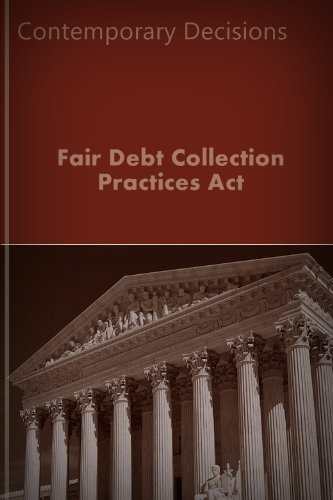
This casebook contains a selection of 165 Federal Court of Appeals decisions that interpret and apply the provisions of the Fair Debt Collection Practices Act. The selection of decisions spans from 2001 to the date of publication. For each federal district, the cases are listed in the order of frequency of citation. The most cited decisions appear first.
The FDCPA bars the use of any false, deceptive, or misleading representation in connection with the collection of any debt. 15 U.S.C. § 1692e. The FDCPA is a strict liability statute; there is no mental state required to violate it.
Further, the FDCPA prohibits contacting a debtor who has "notified a debt collector in writing that the consumer refuses to pay a debt. . . ." irrespective of whether the statement is false under state law or otherwise. 15 U.S.C. § 1692c(c). There are three limited exceptions to this prohibition. Those exceptions are:
(1) to advise the consumer that the debt collector's further efforts are being terminated; (2) to notify the consumer that the debt collector or creditor may invoke specified remedies which are ordinarily invoked by such debt collector or creditor; or (3) where applicable, to notify the consumer that the debt collector or creditor intends to invoke a specified remedy.
Cruz v. International Collection Corp., 673 F. 3d 991 (9th Cir. 2012)
A false representation in connection with the collection of a debt is sufficient to violate the FDCPA facially, even where no misleading or deception is claimed. Bourff v. Rubin Lublin, LLC, 674 F. 3d 1238 (11th Cir. 2012)
[T]he purpose of the FDCPA "is to create a comprehensive statutory framework for the collection of debts owed to the United States government [and to] improve the efficiency and speed in collecting those debts," H.R. Rep. No. 101-736, at 32 (1990), a state law limiting such collection is inconsistent with the purpose of the act and is, therefore, preempted. United States v. Gianelli, 543 F.3d 1178, 1183 (9th Cir. 2008); Federal Trade Commission v. Namer (5th Cir. 2012)