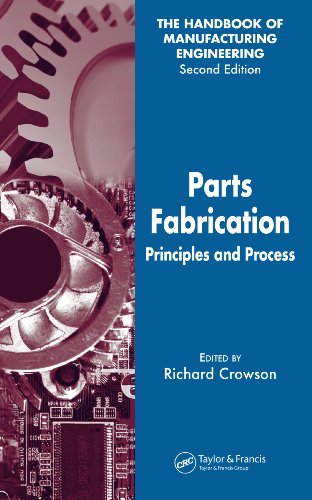


Parts Fabrication: Principles and Process: v. 3 (Handbook of Manufacturing Engineering, Second Edition)
Book Details
PublisherCRC Press
ISBN / ASINB009AI8XFM
ISBN-13978B009AI8XF9
Sales Rank3,064,699
MarketplaceUnited States 🇺🇸
Description
Today's fast-paced manufacturing culture demands a handbook that provides how-to, no-holds-barred, no-frills information. Completely revised and updated, the Handbook of Manufacturing Engineering is now presented in four volumes. Keeping the same general format as the first edition, this latest edition not only provides more information but makes it more accessible. Each individual volume narrows the focus while broadening the coverage, giving you immediate access to the information you need. Volume Three, Parts Fabrication: Principles and Process discusses efficient deductive and systematic approaches to machine debugging while providing a refresher on the principles of structural mechanics.
Edited by Richard Crowson with contributions from experts in each field, the book focuses on establishing communication between manufacturing and design engineers and machine-building technicians. The discussions of engineering design fundamentals, free-body diagrams, stresses, forces, and strength of materials help readers understand and solve counter-intuitive problems. The coverage includes material characteristics of metals, conventional fabrication processes, laser welding, modeling, and nontraditional machining methods.
Assisting design engineers and machine builders in the successful execution of their tasks, the book recommends steps to improve technical problem solving and communication techniques. It provides understanding of how to incorporate deductive reasoning, systematic engineering, human interaction, and corporate cultural influences into manufacturing processes.
Edited by Richard Crowson with contributions from experts in each field, the book focuses on establishing communication between manufacturing and design engineers and machine-building technicians. The discussions of engineering design fundamentals, free-body diagrams, stresses, forces, and strength of materials help readers understand and solve counter-intuitive problems. The coverage includes material characteristics of metals, conventional fabrication processes, laser welding, modeling, and nontraditional machining methods.
Assisting design engineers and machine builders in the successful execution of their tasks, the book recommends steps to improve technical problem solving and communication techniques. It provides understanding of how to incorporate deductive reasoning, systematic engineering, human interaction, and corporate cultural influences into manufacturing processes.
