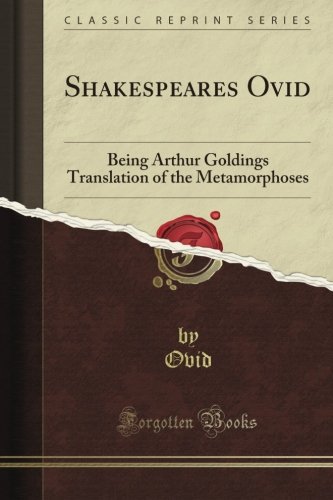


Shakespeare's Ovid: Being Arthur Golding's Translation of the Metamorphoses (Classic Reprint)
Price not available for India
You can still browse on Amazon. Try another country above.
Book Details
Author(s)
Ovid Ovid
Publisher
Forgotten Books
ISBN / ASIN
B009C084PW
ISBN-13
978B009C084P5
Marketplace
India 🇮🇳
Ratings & Reviews
No reviews yet — be the first!
No reviews yet.
Description
A mongst the direct sources of Shakespeare sworks, after North s Plutarch and Holinshed, probably the most important was Ovid. The Fasti, the Heroides, and the Metamorphoses were just such works as would be most likely to impress a young mind; and Shakespeare searly ambition seems to have been to be the English Ovid, whilst accident made him a dramatist. Thus in his Lucrece and his Venus and A donis he directly challenges comparison. His themes are of the same romantic and imaginative stuff; his method the same rich and picturesque description; and the motto upon the title of the Venus and A donis shows that he took the attempt seriously. In this respect he judged truly of his powers, although he enormously underestimated them. Other dramatists have pourtrayed the doings and the fate of men so as to move our souls; but no other has taken us into fairy land, and made imps and fays live before us as Shakespeare has done. Ben Jonson and Middleton have done something for demons and witches; Goethe has realized a devil; but with Shakespeare alone the world of faery seems to be real and reasonable as flesh and blood. Professor T. S. Baynes has shown by a detailed examination, that Shakespeare k:.ew the grammar-school course.1 In Holofernes, the poet represents the pedantic teaching which might have been heard in many a country schoolroom ;and shows his familiarity with the various methods of instruction then in vogue, the technical terms of rhetoric, and the favourite authors. There are besides many references and allusions in Shakespeare to the classical authors, which in part may, but need not be due to floating knowledge. In particular, it is clear that he knew Ovid in the original. On the title page of Venus and A donis, one of the three works which he published himself under his own name, he places the following motto taken from the A mores (I. XV. 35-6), whi
(Typographical errors above are due to OCR software and don't occur in the book.)
(Typographical errors above are due to OCR software and don't occur in the book.)

