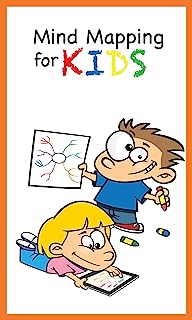


Mind Mapping for Kids: How Elementary School Students Can Use Mind Maps to Improve Reading Comprehension and Critical Thinking
Price not available for France
You can still browse on Amazon. Try another country above.
Book Details
Author(s)
Toni Krasnic
Publisher
Concise Books Publishing
ISBN / ASIN
B00AFYBRTY
ISBN-13
978B00AFYBRT2
Marketplace
France 🇫🇷
Description
Mind Mapping for Kids helps elementary school students develop higher-level thinking and improve their reading comprehension using mind maps and 8 reading comprehension strategies.
Learn mind mapping from a mind mapping expert with whom you can personally connect at any time, not an author who's rehashing materials from others. Krasnic has extensively applied mind maps inside and outside the classroom, has helped thousands of students and professionals, and is the owner of the largest mind mapping community on Google+.
KEY FEATURES
- Learn mind map basics in a few hours and start mind mapping in a day.
- Written by a mind mapper and features mind maps by other mind mappers.
- Includes over 50 mind maps created with over 10 different mind mapping programs.
- Full case study on reading comprehension using mind maps.
DESCRIPTION
We are all visual learners, at least in part. We absorb information visually more than in any other way. Yet, visual literacy is mostly missing from mainstream education. So, how can elementary school students visually represent information and ideas to improve their ability to build on what they already know, think critically, and learn meaningfully?
This question is the central theme of Mind Mapping for Kids. MMFK offers elementary school teachers a blueprint for how to introduce mind maps in their classrooms to help students think more rigorously and increase engagement by transforming linear, static information into connected, dynamic maps.
Part I of the book discusses the fundamentals of mind mapping for teachers, parents, and students. Part II demonstrates how to use mind maps and the eight reading comprehension strategies to help students develop critical thinking and better comprehend what they're reading. Part III provides 15 examples of mind mapping uses in school and at home and 5 templates to use in the classroom.
Give mind maps a try. They can be used independently or in conjunction with other literacy instruction programs. Either way, they will bring fun and excitement to the classroom while simultaneously improving thinking, reading, and learning.
FREE BONUS
To help you get started with mind maps, each book also comes with a free 1-year license of MindMeister ($129 value). To get your free download code, e-mail the author with your proof of book purchase and program preference.
Learn mind mapping from a mind mapping expert with whom you can personally connect at any time, not an author who's rehashing materials from others. Krasnic has extensively applied mind maps inside and outside the classroom, has helped thousands of students and professionals, and is the owner of the largest mind mapping community on Google+.
KEY FEATURES
- Learn mind map basics in a few hours and start mind mapping in a day.
- Written by a mind mapper and features mind maps by other mind mappers.
- Includes over 50 mind maps created with over 10 different mind mapping programs.
- Full case study on reading comprehension using mind maps.
DESCRIPTION
We are all visual learners, at least in part. We absorb information visually more than in any other way. Yet, visual literacy is mostly missing from mainstream education. So, how can elementary school students visually represent information and ideas to improve their ability to build on what they already know, think critically, and learn meaningfully?
This question is the central theme of Mind Mapping for Kids. MMFK offers elementary school teachers a blueprint for how to introduce mind maps in their classrooms to help students think more rigorously and increase engagement by transforming linear, static information into connected, dynamic maps.
Part I of the book discusses the fundamentals of mind mapping for teachers, parents, and students. Part II demonstrates how to use mind maps and the eight reading comprehension strategies to help students develop critical thinking and better comprehend what they're reading. Part III provides 15 examples of mind mapping uses in school and at home and 5 templates to use in the classroom.
Give mind maps a try. They can be used independently or in conjunction with other literacy instruction programs. Either way, they will bring fun and excitement to the classroom while simultaneously improving thinking, reading, and learning.
FREE BONUS
To help you get started with mind maps, each book also comes with a free 1-year license of MindMeister ($129 value). To get your free download code, e-mail the author with your proof of book purchase and program preference.

