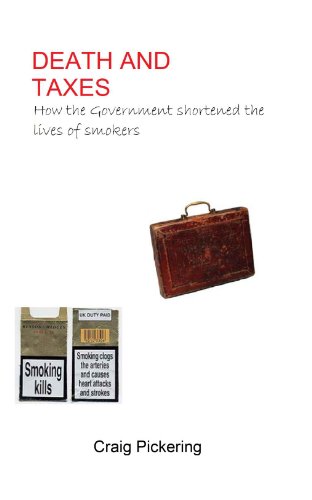


Death and Taxes
Price not available for France
You can still browse on Amazon. Try another country above.
Book Details
Description
DEATH AND TAXES:
How the Government shortened the lives of smokers
This book shows how the British Government put tax revenues before people’s health in taxing smoking. Evidence was suppressed and distorted in the interests of maximising revenues. The Government was especially concerned not to discourage young people from taking up what was known as ‘the habit’. It is a warning from history, relevant to Britain today and the wider world.
The book examines the Government’s ’s policy on tobacco duty between 1945 and the early 1980s, and how it was and, more often how it was not, influenced by the growing awareness that there was a link between smoking and lung cancer, bronchitis and other diseases.
Tobacco duty at its height accounted for a third of indirect tax revenues and a sixth of revenues overall. As the Customs and Excise liked to say (without any sense of irony), it paid for the National Health Service. The main objective of the book is to detail how the needs to maximise revenues and manage the economy for a long time took precedence over the need to protect public health – and indeed they still do.
Treasury Ministers and Prime Ministers, with very few exceptions, were agreed on this stance. Winston Churchill, Denis Healey and Geoffrey Howe come fairly well out of this story, and in different ways Margaret Thatcher and James Callaghan don’t do badly, but Edward Heath appears almost as a silent film villain and Rab Butler and Tony Barber would have done well to be more decisive.
Officials too performed in different ways. Some showed an understanding of the wider implications for public health, others only wanted to protect the revenue. Too often, officials distorted the medical evidence, suppressed material on the impact of duty rises on smoking volumes, and took steps to obstruct any attempt to suggest that tobacco duty might be used to discourage smoking.
The book looks at:
1.A brief introduction to the history of tobacco duty and smoking in the UK.
2.What the tobacco duty policy makers – Ministers and officials – knew about the research on smoking and health, and how they responded. Particular concerns, often shared with the tobacco industry, included the falling number of young people taking up ‘the habit’ and the failure of women to take up smoking in the numbers expected in 1945. Tax policy-makers often took views on medical issues, always seeking, in the early decades, to emphasise that the link between smoking and health was not proven. The book examines, in each period, what Governments did on the basis of this knowledge, in terms of changing and not changing the burden of tobacco duty at Budget time. Mostly, they did nothing for health reasons.
3.Lessons for today: the role of science, especially medical science, in policy-making, especially taxation policy; the future of tobacco duty; the relevance to other current issues, such as the controversy on alcohol abuse.
How the Government shortened the lives of smokers
This book shows how the British Government put tax revenues before people’s health in taxing smoking. Evidence was suppressed and distorted in the interests of maximising revenues. The Government was especially concerned not to discourage young people from taking up what was known as ‘the habit’. It is a warning from history, relevant to Britain today and the wider world.
The book examines the Government’s ’s policy on tobacco duty between 1945 and the early 1980s, and how it was and, more often how it was not, influenced by the growing awareness that there was a link between smoking and lung cancer, bronchitis and other diseases.
Tobacco duty at its height accounted for a third of indirect tax revenues and a sixth of revenues overall. As the Customs and Excise liked to say (without any sense of irony), it paid for the National Health Service. The main objective of the book is to detail how the needs to maximise revenues and manage the economy for a long time took precedence over the need to protect public health – and indeed they still do.
Treasury Ministers and Prime Ministers, with very few exceptions, were agreed on this stance. Winston Churchill, Denis Healey and Geoffrey Howe come fairly well out of this story, and in different ways Margaret Thatcher and James Callaghan don’t do badly, but Edward Heath appears almost as a silent film villain and Rab Butler and Tony Barber would have done well to be more decisive.
Officials too performed in different ways. Some showed an understanding of the wider implications for public health, others only wanted to protect the revenue. Too often, officials distorted the medical evidence, suppressed material on the impact of duty rises on smoking volumes, and took steps to obstruct any attempt to suggest that tobacco duty might be used to discourage smoking.
The book looks at:
1.A brief introduction to the history of tobacco duty and smoking in the UK.
2.What the tobacco duty policy makers – Ministers and officials – knew about the research on smoking and health, and how they responded. Particular concerns, often shared with the tobacco industry, included the falling number of young people taking up ‘the habit’ and the failure of women to take up smoking in the numbers expected in 1945. Tax policy-makers often took views on medical issues, always seeking, in the early decades, to emphasise that the link between smoking and health was not proven. The book examines, in each period, what Governments did on the basis of this knowledge, in terms of changing and not changing the burden of tobacco duty at Budget time. Mostly, they did nothing for health reasons.
3.Lessons for today: the role of science, especially medical science, in policy-making, especially taxation policy; the future of tobacco duty; the relevance to other current issues, such as the controversy on alcohol abuse.
