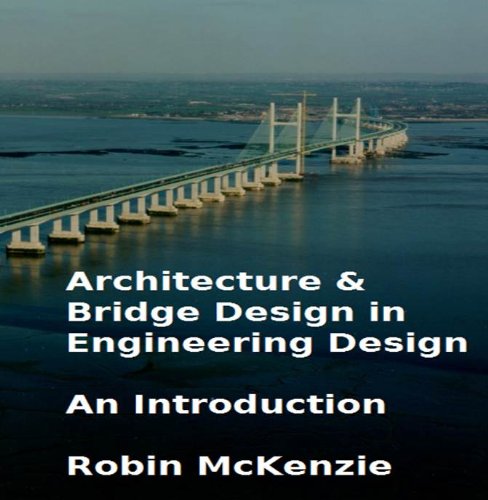


Architecture and Bridge Design in Engineering Design, An Introduction
Book Details
Author(s)
Robin McKenzie
Publisher
Robin McKenzie
ISBN / ASIN
B00BAWM3JI
ISBN-13
978B00BAWM3J9
Category
Kindle Edition
Marketplace
France 🇫🇷
Ratings & Reviews
No reviews yet — be the first!
No reviews yet.
Description
The course, Engineering Design on which this book is based, came about when the author was being interviewed to teach at Cambridge Ruskin International College, based at Anglia Ruskin University, Cambridge. Almost as a throw away comment came this request: “We have this course in engineering. You’re an engineer, I’m sure you can do it!†Thus began a journey that led to this book.
This wide ranging series in technology and its history has in mind two main groups of people.
First, for students primarily at foundation level from a range of disciplines: architecture, computer science based studies, as well as traditional engineering subjects. It complements other mathematics and physics courses taken by computer scientists and engineers, or more creative disciplines taken by architectures and other design based courses.
A second group is for a more general audience who wish to have an appreciation for engineering and its history without the mathematics or physics (however important these are) that can frighten off the reader or lose the reader in the mathematical details.
In essence, this series provides an introduction to technology and its history that the author, looking back, would have liked to have been given at the start of his engineering studies many years ago. As a result the author has spent a life-time learning about these subject areas either from professional or personal interest.
This book is the second part of a series of books on Engineering Design, covers the following subject areas…
2. A history of western architecture, and Design of bridges (this book)
Next we look at architecture, and in particular a history of architecture, stating with the ancient Greeks and Romans of about 2000 years ago. However we then look at the stages of development within Western architecture over the last 1000 years. In any such history, I have selected those areas that I believe give students a full enough understanding: Romanesque, Gothic, Palladian, and Modern.
Related to architecture we then look at the history of bridge design. This is a central aspect of civil engineering. I like teaching about bridges as they have different methods for being built, and this construction is not hidden away as it might be for a building. Moreover, bridges are put up in public spaces. They are easy to see. I give examples within Britain.
This wide ranging series in technology and its history has in mind two main groups of people.
First, for students primarily at foundation level from a range of disciplines: architecture, computer science based studies, as well as traditional engineering subjects. It complements other mathematics and physics courses taken by computer scientists and engineers, or more creative disciplines taken by architectures and other design based courses.
A second group is for a more general audience who wish to have an appreciation for engineering and its history without the mathematics or physics (however important these are) that can frighten off the reader or lose the reader in the mathematical details.
In essence, this series provides an introduction to technology and its history that the author, looking back, would have liked to have been given at the start of his engineering studies many years ago. As a result the author has spent a life-time learning about these subject areas either from professional or personal interest.
This book is the second part of a series of books on Engineering Design, covers the following subject areas…
2. A history of western architecture, and Design of bridges (this book)
Next we look at architecture, and in particular a history of architecture, stating with the ancient Greeks and Romans of about 2000 years ago. However we then look at the stages of development within Western architecture over the last 1000 years. In any such history, I have selected those areas that I believe give students a full enough understanding: Romanesque, Gothic, Palladian, and Modern.
Related to architecture we then look at the history of bridge design. This is a central aspect of civil engineering. I like teaching about bridges as they have different methods for being built, and this construction is not hidden away as it might be for a building. Moreover, bridges are put up in public spaces. They are easy to see. I give examples within Britain.