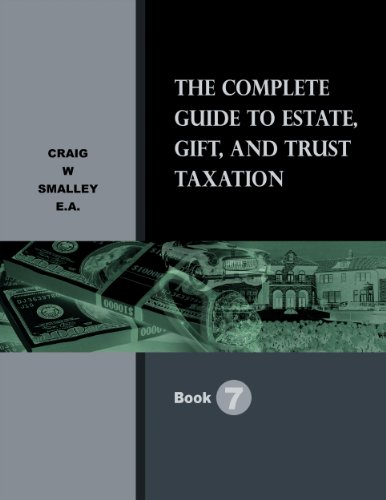


The Complete Guide to Estate, Gift, and Trust Taxation
Price not available for France
You can still browse on Amazon. Try another country above.
Book Details
Author(s)
Craig Smalley EA
Publisher
C.B.G.B. Publishing, LLC
ISBN / ASIN
B00BAYM7XI
ISBN-13
978B00BAYM7X5
Marketplace
France 🇫🇷
Description
As I sit to write my eighth book, I can’t help but wonder will this book be obsolete in the next couple of years? As far as tax law is concerned, there are major changes that will be coming to the estate and gift laws in the near future. As far as this topic is concerned, it is an area of practice that I have gotten more and more familiar with as my clients have begun to age.
The eventuality of estates and gift taxes are forever sealed together in marriage that is rooted in war of all things. You wouldn’t have a gift tax if it weren’t for an estate tax, and you wouldn’t have an estate tax without gift tax. Many, many years ago, the Federal Government decided to tax people’s estates when they died. The idea wasn’t anything new; the ancient Egyptians would levy a 10 percent tax on their citizens when they died. In the United States, the first taste of an estate type tax was the Stamp Act of 1797. The Stamp Act required a Federal stamp on wills on probate. The revenue from Stamp Act helped a virgin country pay off its debts from the Revolutionary War. Clutching to the theme of paying for war, Congress enacted the Tax Act of 1862, for which the proceeds of the tax were used to finance the War Between the States. With the Revenue Act of 1916, which brought us the modern day income tax, also contained a tax on estates. The tax was levied to help finance World War I. However, unlike previous attempts at taxing estates, this time it didn’t go away when the war was over. In 1924, the Gift Tax was added. The Gift Tax was a tax on the transfer of assets from person to person. In 1976, there was a major overhaul of the Estate and Gift tax, which gave us the system we have today.
The Estate and Gift Tax system we have today is intricate and very complicated. As I try to do with all of my books, I will try to break this complicated mess down as best as I can. In this book we will discuss:
• Income in Respect to the Decedent
• Basics Concepts of Gift Tax and Generation Skipping Transfer Tax
• Basic Concepts of Estate Tax
• Basic Concepts of Trusts
• Tax Planning Strategies
The eventuality of estates and gift taxes are forever sealed together in marriage that is rooted in war of all things. You wouldn’t have a gift tax if it weren’t for an estate tax, and you wouldn’t have an estate tax without gift tax. Many, many years ago, the Federal Government decided to tax people’s estates when they died. The idea wasn’t anything new; the ancient Egyptians would levy a 10 percent tax on their citizens when they died. In the United States, the first taste of an estate type tax was the Stamp Act of 1797. The Stamp Act required a Federal stamp on wills on probate. The revenue from Stamp Act helped a virgin country pay off its debts from the Revolutionary War. Clutching to the theme of paying for war, Congress enacted the Tax Act of 1862, for which the proceeds of the tax were used to finance the War Between the States. With the Revenue Act of 1916, which brought us the modern day income tax, also contained a tax on estates. The tax was levied to help finance World War I. However, unlike previous attempts at taxing estates, this time it didn’t go away when the war was over. In 1924, the Gift Tax was added. The Gift Tax was a tax on the transfer of assets from person to person. In 1976, there was a major overhaul of the Estate and Gift tax, which gave us the system we have today.
The Estate and Gift Tax system we have today is intricate and very complicated. As I try to do with all of my books, I will try to break this complicated mess down as best as I can. In this book we will discuss:
• Income in Respect to the Decedent
• Basics Concepts of Gift Tax and Generation Skipping Transfer Tax
• Basic Concepts of Estate Tax
• Basic Concepts of Trusts
• Tax Planning Strategies
