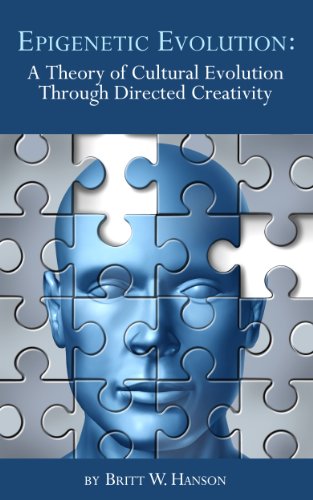


Epigenetic Evolution: A Theory of Cultural Evolution through Directed Creativity
Price not available for France
You can still browse on Amazon. Try another country above.
Book Details
Author(s)
Britt Hanson
Publisher
Britt W. Hanson
ISBN / ASIN
B00C7CBX1O
ISBN-13
978B00C7CBX18
Marketplace
France 🇫🇷
Description
This book offers a solution to a longstanding puzzle: how do humans evolve, and why does this process differ from Darwinian natural selection, which accounts for the evolution of all other species, including our hominid ancestors?
Ever since Darwin, the connections among natural selection, culture, and the evolution of modern humans have been muddled, most recently by sociobiology. The big brain, speech and hearing, and other capacities for culture evolved through natural selection in our ancestors. Yet there has been no significant biological evolution of humans over the past tens of thousands of years. Meanwhile, human societies have evolved dramatically, from small bands of hunters/gatherers to large agricultural civilizations, to enormous contemporary technological civilizations.
Humans evolve primarily through changes in culture—the grand bodies of ideas, knowledge, beliefs, and customs. The theory of directed creativity explains that human minds create, select, and build culture. The “grand library of culture†is stored collectively in human minds, writing, and other media. Culture is transferred from minds to minds through speech, hearing, writing, and reading, not biological reproduction. As a result, the process of creating, selecting, and building culture does not need to enhance the reproductive success of any particular individuals. That is why culture has become largely decoupled from natural selection. But culture still evolves in more or less a Darwinian direction—towards more people extracting and consuming more resources. This is because the psychology that filters thoughts, and calls the brain to action, evolved biologically in our ancestors.
The book explains that culture can be viewed as an epigenetic influence on humans as biological organisms. Humans evolve this epigenetic influence—we evolve epigenetically, distinct from all other species. This has allowed for a vast amount of cultural diversity, across societies and over time.
The theory of cultural evolution builds on a separate book by the same author, Dynastic Theory: The Evolution of Altruism in Animal Societies, to explain why, unique among animals, the bonds of human societies extend far beyond kinship.
The author uses the theory of cultural evolution to devise an evolutionary theory of human nature. The book concludes by analyzing whether the trajectory of humans towards more goods and people is ingrained in us—or whether we can choose our evolutionary trajectory.
Ever since Darwin, the connections among natural selection, culture, and the evolution of modern humans have been muddled, most recently by sociobiology. The big brain, speech and hearing, and other capacities for culture evolved through natural selection in our ancestors. Yet there has been no significant biological evolution of humans over the past tens of thousands of years. Meanwhile, human societies have evolved dramatically, from small bands of hunters/gatherers to large agricultural civilizations, to enormous contemporary technological civilizations.
Humans evolve primarily through changes in culture—the grand bodies of ideas, knowledge, beliefs, and customs. The theory of directed creativity explains that human minds create, select, and build culture. The “grand library of culture†is stored collectively in human minds, writing, and other media. Culture is transferred from minds to minds through speech, hearing, writing, and reading, not biological reproduction. As a result, the process of creating, selecting, and building culture does not need to enhance the reproductive success of any particular individuals. That is why culture has become largely decoupled from natural selection. But culture still evolves in more or less a Darwinian direction—towards more people extracting and consuming more resources. This is because the psychology that filters thoughts, and calls the brain to action, evolved biologically in our ancestors.
The book explains that culture can be viewed as an epigenetic influence on humans as biological organisms. Humans evolve this epigenetic influence—we evolve epigenetically, distinct from all other species. This has allowed for a vast amount of cultural diversity, across societies and over time.
The theory of cultural evolution builds on a separate book by the same author, Dynastic Theory: The Evolution of Altruism in Animal Societies, to explain why, unique among animals, the bonds of human societies extend far beyond kinship.
The author uses the theory of cultural evolution to devise an evolutionary theory of human nature. The book concludes by analyzing whether the trajectory of humans towards more goods and people is ingrained in us—or whether we can choose our evolutionary trajectory.
