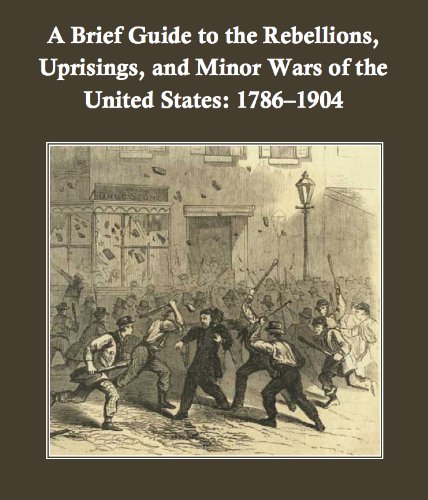


A Brief Guide to the Rebellions, Uprisings, and Minor Wars of the United States: 1786-1904
Book Details
Author(s)
Editors, Encyclopedia Americana
Publisher
A. J. Cornell Publications
ISBN / ASIN
B00CDECBT4
ISBN-13
978B00CDECBT2
Sales Rank
#1,271,782
Marketplace
United States 🇺🇸
Ratings & Reviews
No reviews yet — be the first!
No reviews yet.
Description
Originally published in Encyclopedia Americana in 1920, this Kindle edition, equivalent in length to a physical book of approximately 16 pages, describes 17 U.S. rebellions, uprisings, and minor wars, including Shays’ Rebellion, the Whiskey Rebellion, the Barbary War, Nat Turner’s Rebellion, and the Civil War Draft Riots.
Sample passage:
The announcement that the Federal Government had assumed the right to levy an excise tax was the cause of the insurrection in Pennsylvania which is now commonly referred to as the “Whiskey Rebellion.†The act, which was passed in May 1792, was strenuously opposed on political grounds, the argument against it being that it was dangerous to the doctrine of individual liberty. In the four western counties of Pennsylvania whiskey was a staple product, and, aside from its political aspect, the people felt that such a tax was an unjust discrimination against that region. The attempts to enforce the law were resisted with violence, therefore, and all citizens who advocated conformity to the law, or who quietly conformed to it were subjected to various kinds of ill-treatment by their neighbors. To further inflame the spirit of opposition incendiary posters, all signed “Tom the Tinker,†were displayed in all directions, and there was rioting and bloodshed in many places. In this emergency President Adams assumed control of the situation, and sent 13,000 troops upon Parkinson’s Ferry in time to receive the peace overtures of the rebels. They were not accepted, however, and many arrests were made.
Sample passage:
The announcement that the Federal Government had assumed the right to levy an excise tax was the cause of the insurrection in Pennsylvania which is now commonly referred to as the “Whiskey Rebellion.†The act, which was passed in May 1792, was strenuously opposed on political grounds, the argument against it being that it was dangerous to the doctrine of individual liberty. In the four western counties of Pennsylvania whiskey was a staple product, and, aside from its political aspect, the people felt that such a tax was an unjust discrimination against that region. The attempts to enforce the law were resisted with violence, therefore, and all citizens who advocated conformity to the law, or who quietly conformed to it were subjected to various kinds of ill-treatment by their neighbors. To further inflame the spirit of opposition incendiary posters, all signed “Tom the Tinker,†were displayed in all directions, and there was rioting and bloodshed in many places. In this emergency President Adams assumed control of the situation, and sent 13,000 troops upon Parkinson’s Ferry in time to receive the peace overtures of the rebels. They were not accepted, however, and many arrests were made.
