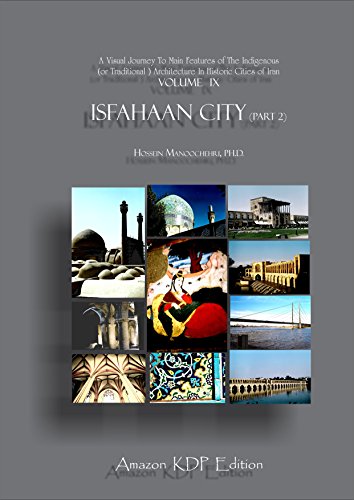


Isfahaan City ( Part 2): A Visual Journey To Main Features of- (The Indigenous (or Traditional ) Architecture in Historic Cities of Iran Book 9)
Book Details
Author(s)
Dr. Hossein Manoochehri
Publisher
Dr. Hossein Manoochehri, Ph.D.
ISBN / ASIN
B00CEH0I9K
ISBN-13
978B00CEH0I95
Sales Rank
#2,087,942
Marketplace
United States 🇺🇸
Ratings & Reviews
No reviews yet — be the first!
No reviews yet.
Description
In this volume, some of the masterpieces of traditional architecture in Iran that are built in Isfahaan City ( --the Capital of Iran during the A,D. 17th and 18th centuries) are put on view for all people of the world. When students of social sciences and of fine arts learn that the builders of such features had zero or little secular education, they will realize the importance of a cultural heritage that is about to extinct because of a rapid modernization process in Iran.
The Traditional Architecture Defined: The traditional (or the clay or the indigenous) architecture in Iran has a long history and may be traced back to the Sumerian time, about 7000 to 5000 years ago. This method of architecture is about to extinct because of a rapid urbanization and modernization in Iran from about the 1940's up to the present time.
The historic cities of Iran ( -- founded prior to the A.D. 1st up to the A.D. 10th century), therefore, are representing two styles of architecture: 1) the traditional (or the clay) architecture backed by centuries of experience and performed by builders with no or little secular education, and 2) a modern architecture backed by educated people with no or little experience. As an example, while a ceiling by the use of brick and clay that is constructed by a traditional builder has lasted several centuries ( and in some cases about 1000 years), a roof in a modern apartment after 10 or 20 years may fall apart.
For this reason, the main features of traditional architecture are both unique and worth recording before they are wiped out completely in the modernization process. The major historic cities of Iran in which a rich historical heritages are still alive have been selected for recording the main features of the traditional architecture pictorially. These cities are mostly founded from 500 B.C. up to the A.D. 10th century. The features in these cities include the heritage houses, the traditional wooden doors of the heritage houses with two knockers in each door ( --one a male knocker and another a female knocker), the wind-catchers (the baadgeirs), the ground water reservoir ( the aab-anbaar),maj-moo'ah (complex or group), baazaar, caravansary, and many more (introduction).
One issue is necessary to be brought to the attention of the publishers and literary agents: The publishing industry in the West may be searching for a work similar to that of Hemingway to be pleased for its publication. On the other hand, producing a pictorial manuscript is similar to a production of a motion picture and it is usually produced by the sponsorship of a government, a state, a university, or a financially strong foundation or publishing house. This is for the first time that a pictorial manuscript, with an academic orientation, is produced by the investment of a free-lanced author. Each volume of my pictorial manuscripts demanded resources that in the West such resources could be used for the production of 20 to 50 novels.
All people in the world, therefore, may visit the historic Isfahaan City by a review of this work while they are just sitting in their offices or rooms and having access to the internet..
The Traditional Architecture Defined: The traditional (or the clay or the indigenous) architecture in Iran has a long history and may be traced back to the Sumerian time, about 7000 to 5000 years ago. This method of architecture is about to extinct because of a rapid urbanization and modernization in Iran from about the 1940's up to the present time.
The historic cities of Iran ( -- founded prior to the A.D. 1st up to the A.D. 10th century), therefore, are representing two styles of architecture: 1) the traditional (or the clay) architecture backed by centuries of experience and performed by builders with no or little secular education, and 2) a modern architecture backed by educated people with no or little experience. As an example, while a ceiling by the use of brick and clay that is constructed by a traditional builder has lasted several centuries ( and in some cases about 1000 years), a roof in a modern apartment after 10 or 20 years may fall apart.
For this reason, the main features of traditional architecture are both unique and worth recording before they are wiped out completely in the modernization process. The major historic cities of Iran in which a rich historical heritages are still alive have been selected for recording the main features of the traditional architecture pictorially. These cities are mostly founded from 500 B.C. up to the A.D. 10th century. The features in these cities include the heritage houses, the traditional wooden doors of the heritage houses with two knockers in each door ( --one a male knocker and another a female knocker), the wind-catchers (the baadgeirs), the ground water reservoir ( the aab-anbaar),maj-moo'ah (complex or group), baazaar, caravansary, and many more (introduction).
One issue is necessary to be brought to the attention of the publishers and literary agents: The publishing industry in the West may be searching for a work similar to that of Hemingway to be pleased for its publication. On the other hand, producing a pictorial manuscript is similar to a production of a motion picture and it is usually produced by the sponsorship of a government, a state, a university, or a financially strong foundation or publishing house. This is for the first time that a pictorial manuscript, with an academic orientation, is produced by the investment of a free-lanced author. Each volume of my pictorial manuscripts demanded resources that in the West such resources could be used for the production of 20 to 50 novels.
All people in the world, therefore, may visit the historic Isfahaan City by a review of this work while they are just sitting in their offices or rooms and having access to the internet..

![Dusseldorf, Frankfurt, and Muenster [ Vol. I of Art and Architecture in Germany and Iran]: A Comparative, Pictorial Presentation of-](https://www.ebooknetworking.net/books/B00/J3Q/medB00J3QJE5O.jpg)
