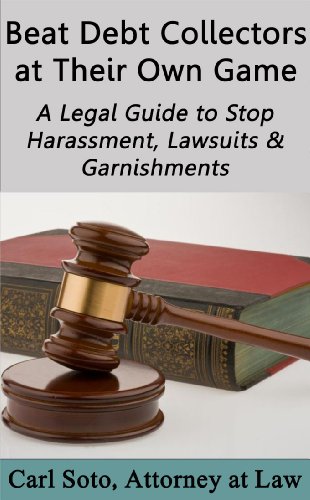


Beat Debt Collectors at Their Own Game: A Legal Guide to Stop Harassment, Lawsuits & Garnishments
Book Details
Author(s)
Carl Soto
Publisher
COPE, Inc.
ISBN / ASIN
B00EP01C2G
ISBN-13
978B00EP01C23
Sales Rank
#687,126
Marketplace
United States 🇺🇸
Description
Written by an attorney specializing in consumer law, this book provides the forms, letters and step-by-step instructions needed to stop harassing calls and letters, win lawsuits, halt garnishments and much more. Written for those with no prior legal experience, it explains in straight-forward, non-technical language everything you need to know to beat debt collectors. This book covers every aspect of the debt collection process: default, collection calls & letters, lawsuits, garnishments, negotiating settlements and appeals.
If you are being sued by a collection company this book is a must-have. Virtually everyone applying the simple defenses laid out in this book has had their collection case dismissed and walked out of court without paying a dime – permanently. This is no gimmick; it's the application of basic legal defenses, easily and successfully applied by anyone who can understand this Description.
This "inside" peek into the collection industry shows you how to beat them at their own game once you understand how they operate. Currently, the seven companies dominating the debt collection industry collectively own over $137 billion of defaulted credit card debt -- for which they paid less than 5 cents on the dollar. What they actually purchase from issuing banks are databases of defaulted debtors. However, they have no supporting documentation -- no evidence whatsoever that any individual listed in these data bases owes anyone anything.
This is irrelevant to debt collection companies, who know that virtually every debtor they contact will simply assume they have adequate evidence. Collection agencies play on this misconception and aggressively attempt to collect on the debt they purchased. If they fail to obtain a recovery after a year or two of telephone calls and letters, they eventually file a collection lawsuit.
Without a document signed by the consumer, these lawsuits are fatally flawed and would be summarily dismissed by a judge if challenged. However, 95% of the time, debtors don't appear in court to defend themselves, and the collection company automatically wins by default judgment: no evidence is examined, and the judge doesn't even review the file. Judgment is immediately entered and the next case called. Collection companies, well aware of this, never prepare a properly documented case against anyone. It isn't necessary -- more importantly, it isn't cost effective. As a result, a tidal wave of over a million fraudulent debt collection lawsuits are filed every year.
To win your case, show up in court and follow the steps laid out in this book. Everything you need to know is provided: what paper work to file, what to wear, how to find the court room, who to check in with, how to address the judge, what documents to bring and – most important -- what to say. It’s easy, it’s straight-forward, and it’s incredibly effective.
If you are being sued by a collection company this book is a must-have. Virtually everyone applying the simple defenses laid out in this book has had their collection case dismissed and walked out of court without paying a dime – permanently. This is no gimmick; it's the application of basic legal defenses, easily and successfully applied by anyone who can understand this Description.
This "inside" peek into the collection industry shows you how to beat them at their own game once you understand how they operate. Currently, the seven companies dominating the debt collection industry collectively own over $137 billion of defaulted credit card debt -- for which they paid less than 5 cents on the dollar. What they actually purchase from issuing banks are databases of defaulted debtors. However, they have no supporting documentation -- no evidence whatsoever that any individual listed in these data bases owes anyone anything.
This is irrelevant to debt collection companies, who know that virtually every debtor they contact will simply assume they have adequate evidence. Collection agencies play on this misconception and aggressively attempt to collect on the debt they purchased. If they fail to obtain a recovery after a year or two of telephone calls and letters, they eventually file a collection lawsuit.
Without a document signed by the consumer, these lawsuits are fatally flawed and would be summarily dismissed by a judge if challenged. However, 95% of the time, debtors don't appear in court to defend themselves, and the collection company automatically wins by default judgment: no evidence is examined, and the judge doesn't even review the file. Judgment is immediately entered and the next case called. Collection companies, well aware of this, never prepare a properly documented case against anyone. It isn't necessary -- more importantly, it isn't cost effective. As a result, a tidal wave of over a million fraudulent debt collection lawsuits are filed every year.
To win your case, show up in court and follow the steps laid out in this book. Everything you need to know is provided: what paper work to file, what to wear, how to find the court room, who to check in with, how to address the judge, what documents to bring and – most important -- what to say. It’s easy, it’s straight-forward, and it’s incredibly effective.
