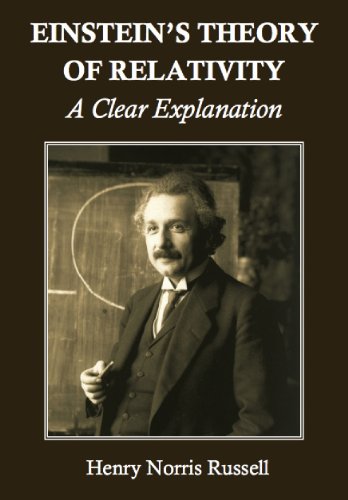


Einstein's Theory of Relativity: A Clear Explanation
Book Details
Author(s)
Henry Norris Russell
Publisher
A. J. Cornell Publications
ISBN / ASIN
B00F3CY088
ISBN-13
978B00F3CY089
Sales Rank
#221,214
Marketplace
United States 🇺🇸
Description
Astronomy Professor Henry Norris Russell’s clear and understandable math-free explanation of Einstein’s theory of relativity was first delivered in 1920 as a lecture at Princeton University, and was then published in 1921 in the Annual Report of the Smithsonian Institution. This Kindle edition, equivalent in length to a physical book of approximately 20 pages, contains the complete text of Professor Russell’s lecture.
Sample passage:
After various minor hypotheses had been tried, Einstein started in with the bold assumption that these experiments had unveiled a new law of nature; namely, that the universe was so constructed that it was not possible by any physical experiment, optical or otherwise, to detect the existence of absolute, uniform, straight-ahead motion, or indeed to determine whether the observer’s frame of reference was at rest or in such uniform translational motion. If this is true, it follows that it is only the relative motions of material bodies in the universe which we can study at all. Hence the name of the “Principle of relativity.†A second principle, following naturally from the experiments which led to the first, is that the velocity of light in empty space will always come out the same, whether measured by an observer moving, with his apparatus, in one direction at one rate or by one similarly moving in another direction and at a different rate.
About the author
Henry Norris Russell (1877–1957) was Professor of Astronomy at Princeton University from 1905 to 1947. Other works include “The Solar System†and “Astrophysics and Stellar Astronomy.â€
Sample passage:
After various minor hypotheses had been tried, Einstein started in with the bold assumption that these experiments had unveiled a new law of nature; namely, that the universe was so constructed that it was not possible by any physical experiment, optical or otherwise, to detect the existence of absolute, uniform, straight-ahead motion, or indeed to determine whether the observer’s frame of reference was at rest or in such uniform translational motion. If this is true, it follows that it is only the relative motions of material bodies in the universe which we can study at all. Hence the name of the “Principle of relativity.†A second principle, following naturally from the experiments which led to the first, is that the velocity of light in empty space will always come out the same, whether measured by an observer moving, with his apparatus, in one direction at one rate or by one similarly moving in another direction and at a different rate.
About the author
Henry Norris Russell (1877–1957) was Professor of Astronomy at Princeton University from 1905 to 1947. Other works include “The Solar System†and “Astrophysics and Stellar Astronomy.â€