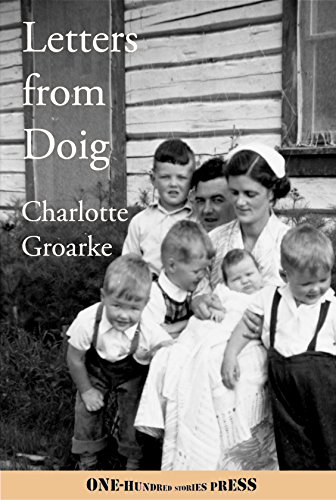


Letters from Doig: Letters to My Dear Ones in Ireland, 1955-1958 (The writing of John and Charlotte Groarke)
Price not available for France
You can still browse on Amazon. Try another country above.
Book Details
Author(s)
Charlotte Groarke
Publisher
One Hundred Stories Press
ISBN / ASIN
B00FKBBMN8
ISBN-13
978B00FKBBMN2
Marketplace
France 🇫🇷
Ratings & Reviews
No reviews yet — be the first!
No reviews yet.
Description
The letters, drawings, and photos in LETTERS FROM THE DOIG RIVER SCHOOL tell an immigrant’s story and is the first volume in a two-volume set of books featuring the writing of John and Charlotte Groarke. The book contains a collection of letters written by Charlotte Groarke to her family at home in Ireland from Doig River, B.C. between 1955 and 1958. The letters recount her efforts to establish her household on the Doig River Indian Reserve in the Peace River District, where John Groarke had accepted a teaching post, just outside the reach of the existing roads. There she faced many harsh realities, which included cultural isolation, the raw exigencies of life at the edge of the bush, and the many hardships suffered by her Beaver and Cree neighbours, who had been marginalized by the process of colonization.
The book describes Charlotte Groarke’s life on the reserve, the ups and downs of family life, and her longing for home. She describes her work as a nurse and shares her observations on the opening up of the Peace River country, which was still a frontier. The last letters chronicle the family’s move to St. Bruno, Quebec. There are moments of discovery, and reflection, and many insights into the emotional rigours of immigration and the process of becoming a Canadian.
Charlotte Groarke is the grand-daughter of Emily Pearse, the half-sister of Patrick Pearse, who was executed for leading the Easter Uprising (now called “the Rising”) in Ireland in 1916. After training as a nurse in England, she married John Groarke, a teacher, and took up married life in London. After having four sons, including a set of triplets, the family emigrated to Canada. Charlotte Groarke's writing is full of immediacy: the tone of her letters is fresh, informative, confiding, and open to experience. Her letters also have a lyrical side, which finds dignity, poignancy and humour in ordinary life. LETTERS FROM DOIG captures the spirit of a more formal era with warmth and frankness and provides a sympathetic account of a woman’s life in a neglected period of Canadian history.
The book describes Charlotte Groarke’s life on the reserve, the ups and downs of family life, and her longing for home. She describes her work as a nurse and shares her observations on the opening up of the Peace River country, which was still a frontier. The last letters chronicle the family’s move to St. Bruno, Quebec. There are moments of discovery, and reflection, and many insights into the emotional rigours of immigration and the process of becoming a Canadian.
Charlotte Groarke is the grand-daughter of Emily Pearse, the half-sister of Patrick Pearse, who was executed for leading the Easter Uprising (now called “the Rising”) in Ireland in 1916. After training as a nurse in England, she married John Groarke, a teacher, and took up married life in London. After having four sons, including a set of triplets, the family emigrated to Canada. Charlotte Groarke's writing is full of immediacy: the tone of her letters is fresh, informative, confiding, and open to experience. Her letters also have a lyrical side, which finds dignity, poignancy and humour in ordinary life. LETTERS FROM DOIG captures the spirit of a more formal era with warmth and frankness and provides a sympathetic account of a woman’s life in a neglected period of Canadian history.
