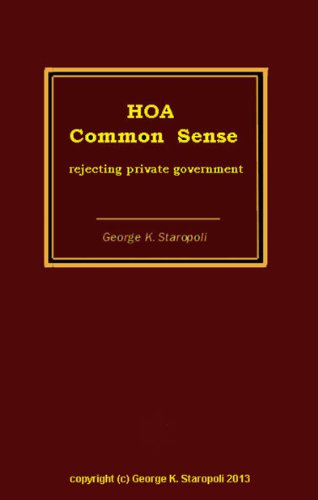


HOA Common Sense: rejecting private govrnment
Book Details
Author(s)George K Staropoli
PublisherStarMan Publishing, LLC
ISBN / ASINB00GL6J7BU
ISBN-13978B00GL6J7B9
MarketplaceGermany 🇩🇪
Description
The title of this pamphlet, “Common Sense,†was chosen to identify and relate to the aims and purposes of the original 1776 pamphlet by Thomas Paine, Common Sense. Prior to the American Revolution it was Paine who provided the reasons and justifications for overthrowing the oppression government of King George III. He raised the consciousness of the colonists as to their second-class citizenship with respect to the British Empire, and something had to be done about. It was widely read by the Founding Fathers who did do something about it.
With a similar object in regard to oppressive, authoritarian HOA regimes, I present a summary of the essential issues that must be similarly remedied to bring about substantive changes to planned community/condo private governance.
In this short booklet the author presents his analysis of how homeowners associations have impacted our social and political society. With 13 years as a homeowner rights activist, the author steps outside the box created by the special interest promoters of the HOA legal scheme. Staropoli describes the HOA as secessionist, authoritarian private governments operating outside the supreme law of the land, the US Constitution.
Supporting his view, HOA Common Sense contains references and authorities. He argues that the founders of the HOA concept in 1964 well knew that in order for the profit-seeking promoters to be successful in the mass merchandising HOAs to unsuspecting buyers, they had to avoid any implication or assertion that HOAs were governments. For obvious reasons. HOAs had to be coercive and oppressive, mandating membership and compulsory dues, and denying owners the rights and privileges that they had before buying the HOA property.
Staropoli briefly presents the areas requiring substantive legislation to return the HOA from an independent principality or territory to a public entity subject to the Constitution. He argues it can be done today with existing state laws without impacting the private amenities, rules and regulations, etc. of the HOA. The HOA can accomplish these goals within public government statutes. Or can they?
The areas presented include: the second American experiment in government, due process failures, the need for clean elections, the board can do no wrong, draconian foreclosure rights, HOAs as de facto governments, and the consent to be governed.
The author, George K. Staropoli, is a nationally recognized homeowner rights advocate who has won a lawsuit against the State of Arizona for passing unconstitutional HOA bills.
With a similar object in regard to oppressive, authoritarian HOA regimes, I present a summary of the essential issues that must be similarly remedied to bring about substantive changes to planned community/condo private governance.
In this short booklet the author presents his analysis of how homeowners associations have impacted our social and political society. With 13 years as a homeowner rights activist, the author steps outside the box created by the special interest promoters of the HOA legal scheme. Staropoli describes the HOA as secessionist, authoritarian private governments operating outside the supreme law of the land, the US Constitution.
Supporting his view, HOA Common Sense contains references and authorities. He argues that the founders of the HOA concept in 1964 well knew that in order for the profit-seeking promoters to be successful in the mass merchandising HOAs to unsuspecting buyers, they had to avoid any implication or assertion that HOAs were governments. For obvious reasons. HOAs had to be coercive and oppressive, mandating membership and compulsory dues, and denying owners the rights and privileges that they had before buying the HOA property.
Staropoli briefly presents the areas requiring substantive legislation to return the HOA from an independent principality or territory to a public entity subject to the Constitution. He argues it can be done today with existing state laws without impacting the private amenities, rules and regulations, etc. of the HOA. The HOA can accomplish these goals within public government statutes. Or can they?
The areas presented include: the second American experiment in government, due process failures, the need for clean elections, the board can do no wrong, draconian foreclosure rights, HOAs as de facto governments, and the consent to be governed.
The author, George K. Staropoli, is a nationally recognized homeowner rights advocate who has won a lawsuit against the State of Arizona for passing unconstitutional HOA bills.
