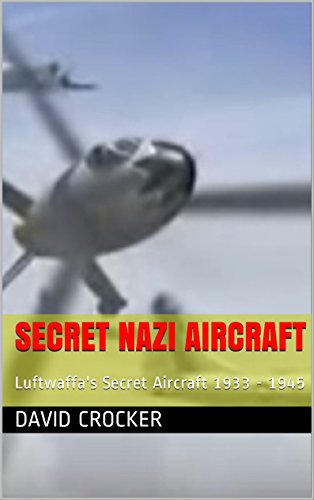


Secret Nazi Aircraft: Luftwaffa's Secret Aircraft 1933 - 1945
Book Details
Author(s)
Crocker, David
ISBN / ASIN
B00IB5Z1PU
ISBN-13
978B00IB5Z1P6
Category
Kindle Edition
Marketplace
France 🇫🇷
Ratings & Reviews
No reviews yet — be the first!
No reviews yet.
Description
This book is a compilation of surviving technical data and engineering information on the aircraft projects that were ongoing in Germany between the years 1939 and 1945. A short section of background material is also given at the beginning of each chapter, to help readers appreciate the environment and culture that existed at these research organizations in those times. This background material was found in Wikipedia, the free encyclopedia.
A basic knowledge of aircraft terminology is assumed. The system of units in which the aircraft specifications are quoted is the American customary units which were used for the design of most Allied aircraft used in World War 2 and are the same as those recorded by the Allies when interrogating captured aircraft designers. This choice of units allows for a direct comparison between the secret German aircraft and equivalent Allied aircraft types.
It wasn’t until 1965 was the SI system adopted in the UK. Australia adopted it in1970 and even today the western Hemisphere still uses the pound-foot-mile system for aeronautical matters.
The projects were selected for their advanced technological content and their unorthodox approach to aircraft design. To the reader many of these programs may have a familiar look and that is not too surprising; since they were to be the inspiration and source of engineering data, for most aeronautical research work, that was to take place in the world throughout the later part of the century.
Aeronautical development that took place in the West and also in the Eastern bloc had their beginnings in Germany during WW2. This trend was to continue for at least three decades following the end of hostilities in Europe. Familiar war-birds such as the Sabre Jet and the MIG 15 are direct descendants of projects which started at Messerschmitt and Focke-Wulf.
Who can deny the resemblance of those fighters that emerged in 1950’s to the Ta 153 and the ME P 1101 of the 1940’s. The so called groundbreaking supersonic Bell X series of aircraft flown by legendary test pilot Chuck Yeager in the 1950’s had their beginnings in the high-speed research programs of the Nazi regime (8-346 supersonic research aircraft).
The material in this volume includes more engineering data than our earlier book. One of my engineering professors once said, that unless one could quantify a fact with a number, it was of little value. Following this thought, this work contains as much engineering data as could be found and is assigned to each project and aircraft design appearing here.
The project material in this book has been arranged so that the manufacturers are listed in alphabetical order, making it more convenient for the reader to follow the development work that was proceeding in the company’s advance design offices (“Skunk-Worksâ€).
The material found in this compilation could also form a valuable source of information for flight simulator games, aero modelers both 1/72nd and giant scale RC Jets. Jet propelled models or for that matter, any aircraft model could be scaled up from the dimensions and engineering data found in these pages. Imagine the prospects of a scale ME 1101, a TA 183 or even an RC model of the Focke-Wulf ATHODYD (ramjet) fighter performing at some local jet rally.
Note to the reader: The hyperlinks embedded in this eBook will only work if your reading device is actively connected to the Internet.
This Third Edition now has a fully hyper-linked Table of Contents to facilitate easy navigating within the book. The material has also been rearranged in a more logical order so that the information is easier to understand.
A basic knowledge of aircraft terminology is assumed. The system of units in which the aircraft specifications are quoted is the American customary units which were used for the design of most Allied aircraft used in World War 2 and are the same as those recorded by the Allies when interrogating captured aircraft designers. This choice of units allows for a direct comparison between the secret German aircraft and equivalent Allied aircraft types.
It wasn’t until 1965 was the SI system adopted in the UK. Australia adopted it in1970 and even today the western Hemisphere still uses the pound-foot-mile system for aeronautical matters.
The projects were selected for their advanced technological content and their unorthodox approach to aircraft design. To the reader many of these programs may have a familiar look and that is not too surprising; since they were to be the inspiration and source of engineering data, for most aeronautical research work, that was to take place in the world throughout the later part of the century.
Aeronautical development that took place in the West and also in the Eastern bloc had their beginnings in Germany during WW2. This trend was to continue for at least three decades following the end of hostilities in Europe. Familiar war-birds such as the Sabre Jet and the MIG 15 are direct descendants of projects which started at Messerschmitt and Focke-Wulf.
Who can deny the resemblance of those fighters that emerged in 1950’s to the Ta 153 and the ME P 1101 of the 1940’s. The so called groundbreaking supersonic Bell X series of aircraft flown by legendary test pilot Chuck Yeager in the 1950’s had their beginnings in the high-speed research programs of the Nazi regime (8-346 supersonic research aircraft).
The material in this volume includes more engineering data than our earlier book. One of my engineering professors once said, that unless one could quantify a fact with a number, it was of little value. Following this thought, this work contains as much engineering data as could be found and is assigned to each project and aircraft design appearing here.
The project material in this book has been arranged so that the manufacturers are listed in alphabetical order, making it more convenient for the reader to follow the development work that was proceeding in the company’s advance design offices (“Skunk-Worksâ€).
The material found in this compilation could also form a valuable source of information for flight simulator games, aero modelers both 1/72nd and giant scale RC Jets. Jet propelled models or for that matter, any aircraft model could be scaled up from the dimensions and engineering data found in these pages. Imagine the prospects of a scale ME 1101, a TA 183 or even an RC model of the Focke-Wulf ATHODYD (ramjet) fighter performing at some local jet rally.
Note to the reader: The hyperlinks embedded in this eBook will only work if your reading device is actively connected to the Internet.
This Third Edition now has a fully hyper-linked Table of Contents to facilitate easy navigating within the book. The material has also been rearranged in a more logical order so that the information is easier to understand.




![Bow Down to the Wolf King [Royal Alphas 1] (Siren Publishing Everlasting Classic ManLove)](https://www.ebooknetworking.net/books/B00/KPV/medB00KPVMQ42.jpg)