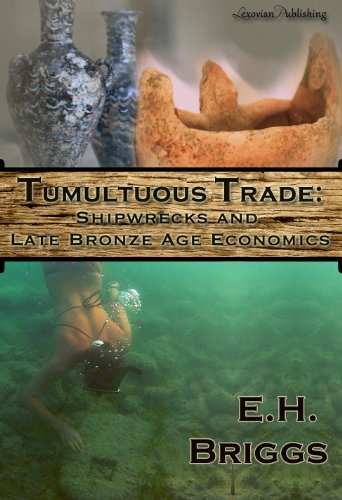


Tumultuous Trade: Shipwrecks and Late Bronze Age Economics
Book Details
Author(s)E.H. Briggs
PublisherLexovien Publishing
ISBN / ASINB00IOXFU78
ISBN-13978B00IOXFU71
Sales Rank788,185
MarketplaceUnited States 🇺🇸
Description
The primary purpose of this book is to explore the contribution of underwater archaeology to the study of the ancient economy, with special reference to Bronze Age shipwrecks.
The discreet nature of shipwreck contexts means that they provide a unique insight into contemporary assemblages, an insight which is much more difficult to obtain on terrestrial sites where the context is easily obscured due to subsequent activity over the centuries.
As will be shown, the opinions regarding Bronze Age economic systems are divided: different schools of thought contribute to a sharp dichotomy on the subject, with extreme views expressed by both sides. Neither the primitivist nor the modernist viewpoint is sufficient in accounting for the complexities and interconnectivity of trade in the Late Bronze Age. Based on evidence from shipwrecks, a synthesis of these extreme views best suits the evidence, and a new model for Bronze Age economics will be proposed that incorporates both sides of the debate in a moderate fashion.
First I shall explore the relationship between archaeology and the ancient economy. Next the actual evidence from two Bronze Age shipwrecks will be discussed with special reference to the way in which these finds have contributed to economic debates. These finds include primarily the metal cargo, but also resin, glass, and fruits. Then I shall examine the debates on provenance for these two wrecks and possible terrestrial parallels for the finds recovered, and why this is important to the arguments surrounding economic systems of the period. Finally I shall propose a synthesis of the divergent views on the ancient economy.
The secondary purpose of this book is to illustrate the usefulness of underwater archaeology: if it can be shown that these shipwrecks contribute in any small way to our understanding of the Late Bronze Age, then criticism attacking the merits of underwater archaeology is unfounded.
The discreet nature of shipwreck contexts means that they provide a unique insight into contemporary assemblages, an insight which is much more difficult to obtain on terrestrial sites where the context is easily obscured due to subsequent activity over the centuries.
As will be shown, the opinions regarding Bronze Age economic systems are divided: different schools of thought contribute to a sharp dichotomy on the subject, with extreme views expressed by both sides. Neither the primitivist nor the modernist viewpoint is sufficient in accounting for the complexities and interconnectivity of trade in the Late Bronze Age. Based on evidence from shipwrecks, a synthesis of these extreme views best suits the evidence, and a new model for Bronze Age economics will be proposed that incorporates both sides of the debate in a moderate fashion.
First I shall explore the relationship between archaeology and the ancient economy. Next the actual evidence from two Bronze Age shipwrecks will be discussed with special reference to the way in which these finds have contributed to economic debates. These finds include primarily the metal cargo, but also resin, glass, and fruits. Then I shall examine the debates on provenance for these two wrecks and possible terrestrial parallels for the finds recovered, and why this is important to the arguments surrounding economic systems of the period. Finally I shall propose a synthesis of the divergent views on the ancient economy.
The secondary purpose of this book is to illustrate the usefulness of underwater archaeology: if it can be shown that these shipwrecks contribute in any small way to our understanding of the Late Bronze Age, then criticism attacking the merits of underwater archaeology is unfounded.
