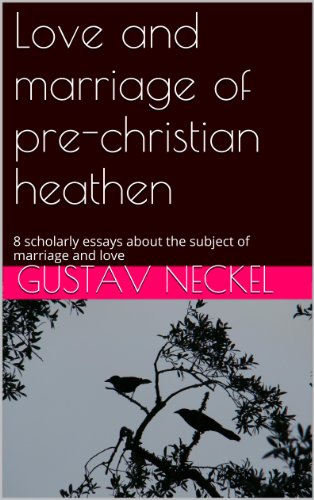


Love and marriage of pre-christian heathen: 8 scholarly essays about the subject of marriage and love
Price not available for France
You can still browse on Amazon. Try another country above.
Book Details
Author(s)
Gustav Neckel
Publisher
heathen libraries
ISBN / ASIN
B00JCJCRBA
ISBN-13
978B00JCJCRB2
Marketplace
France 🇫🇷
Ratings & Reviews
No reviews yet — be the first!
No reviews yet.
Description
Prof. Neckel wrote 8 essays about the marriage and love in heathen time. He first had to deconstruct misconception by the catholic church, which was eager to show that the people lived in wild and primitive conditions and Christianity brought light and enobling attitudes to the heathen. Prof. Neckel shows clearly that this was not the case but through the misogyny of the church it was the opposite. The abuse of women started with Christianity. As Christianity has a negative view of marriage, they see that as a hindrance to the union with God, this shines through in all their writings.
Another dogma was that of historians who wanted to prove that the present condition was the epitome of cultural development and therefore saw all sources and evidence through this lense, which led to a distorted description of heathen marriage and love.
The law historians read out of the law documents that the woman was bought like cattle and thus also treated. They considered her not much higher than a slave.
Prof. Neckel shows a very different point of view and argues well with the profound knowledge of the Edda and the sagas and as well the law documents.
He proves that the future bride was secured by the transfer of substantial parts of the real estate of the bride groom plus movable assets. If the marriage was a failed one, the woman was secure in all her dealings and thus kept her independency. Sometimes 30 % of the real estate was signed over to the woman and with the birth of an heir sometimes up to 50 %. This property was the womans for life. the woman brought Mahl treasure into the marriage, household items necessary for a marriage, but this always stayed as her property.
The father in general made the deals with the suitor, as he was supposed to be more life experienced, and the matter was delicate and therefore it was beneficial if not the girl dealed with the suitor but her father.
The marriages were matters between clans. but they were not forced marriages, the girl had the right to decide and sometimes did so, but mostly complied with the clans interest. In general when the girl objected one knew that the risk of a failed marriage was high and both families tried to avoid it.
There have been different types of marriage. The most common was the legal marriage with a contract, mund treasure (the security the bride groom handed over to the girl) and Mahl treasure (what the girl brought into the marriage), inheritance rights of the children and publication, the express permission of the father or head of clan and the agreeing of the girl.
Other forms of marriage was for example the socalled Friedel marriage, where the girl left the family and lived together with her suitor without any contract, security, inheritance right of children and so on. Herrmann the Cherusker and Thusnelda are the famous example of this.
Prof. Neckel also investigates the situation of the woman in the marriage. there was no punishment rights by the husband, as claimed by the law historians, to the contrary, a slab in the face was considered a reason for divorce. In all the sagas and other writings there is no moral judgement of women at all, no matter how big the missteps were, she made. A woman was considered as not vioable, in case of war, revenge or general killings between the men, she was always save. No one harmed her.
Heathen live monogamous contrary to what churchwriters wrote. Nobles sometimes had several women, but Prof Neckel proofed that these were successive and not at the same time. Powerful Nobles were sought after by other clans to have family connections and thus they married several times. The divorced women often stayed in the house of her former husband, mostly because of the children, but the rights and status of wife was taken by another one.
Prof. Neckel writes with great sympathy for his subject and shows the life of heathen in a way not seen before.
Another dogma was that of historians who wanted to prove that the present condition was the epitome of cultural development and therefore saw all sources and evidence through this lense, which led to a distorted description of heathen marriage and love.
The law historians read out of the law documents that the woman was bought like cattle and thus also treated. They considered her not much higher than a slave.
Prof. Neckel shows a very different point of view and argues well with the profound knowledge of the Edda and the sagas and as well the law documents.
He proves that the future bride was secured by the transfer of substantial parts of the real estate of the bride groom plus movable assets. If the marriage was a failed one, the woman was secure in all her dealings and thus kept her independency. Sometimes 30 % of the real estate was signed over to the woman and with the birth of an heir sometimes up to 50 %. This property was the womans for life. the woman brought Mahl treasure into the marriage, household items necessary for a marriage, but this always stayed as her property.
The father in general made the deals with the suitor, as he was supposed to be more life experienced, and the matter was delicate and therefore it was beneficial if not the girl dealed with the suitor but her father.
The marriages were matters between clans. but they were not forced marriages, the girl had the right to decide and sometimes did so, but mostly complied with the clans interest. In general when the girl objected one knew that the risk of a failed marriage was high and both families tried to avoid it.
There have been different types of marriage. The most common was the legal marriage with a contract, mund treasure (the security the bride groom handed over to the girl) and Mahl treasure (what the girl brought into the marriage), inheritance rights of the children and publication, the express permission of the father or head of clan and the agreeing of the girl.
Other forms of marriage was for example the socalled Friedel marriage, where the girl left the family and lived together with her suitor without any contract, security, inheritance right of children and so on. Herrmann the Cherusker and Thusnelda are the famous example of this.
Prof. Neckel also investigates the situation of the woman in the marriage. there was no punishment rights by the husband, as claimed by the law historians, to the contrary, a slab in the face was considered a reason for divorce. In all the sagas and other writings there is no moral judgement of women at all, no matter how big the missteps were, she made. A woman was considered as not vioable, in case of war, revenge or general killings between the men, she was always save. No one harmed her.
Heathen live monogamous contrary to what churchwriters wrote. Nobles sometimes had several women, but Prof Neckel proofed that these were successive and not at the same time. Powerful Nobles were sought after by other clans to have family connections and thus they married several times. The divorced women often stayed in the house of her former husband, mostly because of the children, but the rights and status of wife was taken by another one.
Prof. Neckel writes with great sympathy for his subject and shows the life of heathen in a way not seen before.
