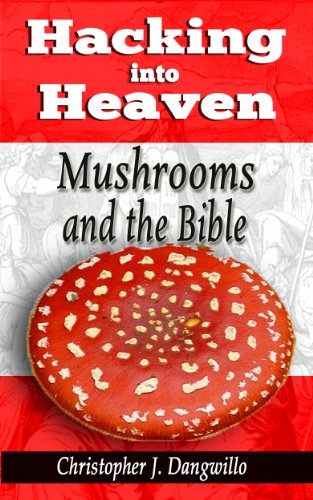


Hacking into Heaven: Mushrooms and the Bible
Price not available for France
You can still browse on Amazon. Try another country above.
Book Details
Author(s)
Christopher Dangwillo
Publisher
IM Publishing
ISBN / ASIN
B00JFDN0WI
ISBN-13
978B00JFDN0W2
Marketplace
France 🇫🇷
Description
"Hacking into Heaven: Mushrooms and the Bible" offers an alternative interpretation of the Bible that will forever change the way you think about religion and language. An interpretation that hacks into the symbols of the Bible to reveal it for what it is - a secret society's play book on how to rule over the teeming masses by denying them access to the Tree of Knowledge of Good and Evil- the mushroom Amanita muscaria. Dangwillo provides a clear and concise explanation of how written language and religion have been used to continue the practice of slavery. Also, included are the essays "Spelunking into Plato's Cave" and "A Neuro-linguistic Model for Amanita Muscaria Ecstasy".
From "Language, Religion, and Slavery":
The founding fathers' of the United States of America used the ancient empires of Greece and Rome as models for their democratic experiment; and this should come as no surprise because the Americans found themselves in a similar situation to that of the Ancient Greeks and Romans – a wealthy elite minority ruling over an impoverished servant majority. As a result, democracies are inherently divided into masters and servants; owners and owned; and, initiated and uninitiated. Friedrich Nietzsche noted in The Genealogy of Morals that the language used to describe these binary pairs distinguished one’s class and suggested a typical character trait. The word the Greek aristocracy used to describe themselves was esthlos, meaning one who has “true reality.†This is in contrast to the lying plebeian. In such a system, metaphor and irony work in conjunction to communicate information that assumes a dual audience, consisting of one group that only understands the literal meaning, and another group that understands the literal and symbolic meanings. Consider too that the word irony originates from the Greek eironeia, which means “feigned ignorance.â€
From "Language, Religion, and Slavery":
The founding fathers' of the United States of America used the ancient empires of Greece and Rome as models for their democratic experiment; and this should come as no surprise because the Americans found themselves in a similar situation to that of the Ancient Greeks and Romans – a wealthy elite minority ruling over an impoverished servant majority. As a result, democracies are inherently divided into masters and servants; owners and owned; and, initiated and uninitiated. Friedrich Nietzsche noted in The Genealogy of Morals that the language used to describe these binary pairs distinguished one’s class and suggested a typical character trait. The word the Greek aristocracy used to describe themselves was esthlos, meaning one who has “true reality.†This is in contrast to the lying plebeian. In such a system, metaphor and irony work in conjunction to communicate information that assumes a dual audience, consisting of one group that only understands the literal meaning, and another group that understands the literal and symbolic meanings. Consider too that the word irony originates from the Greek eironeia, which means “feigned ignorance.â€
