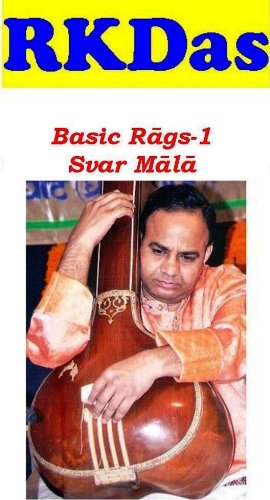


Basic Raags-1 (Svar Maalaa)
Description
There is a lot of information available in the internet on the r?gas/ r?gs (systematised Indian melodies made of musical notes) of Indian music. In most of the cases they are based on the books written by some of the so called great musicologists. They lack proper analysis, backing of practical music and olden treatises of music, and prevalent age old tradition of the ust?ds and the practising masters of music.
A mere description of r?gs is not sufficient to understand the structure of r?gs, unless they are accompanied by r?g representative compositions comprising tones and rhythm (and lyrics). Every r?g is made of musical tones/ notes and they can be rendered with the help of lyrics or by a string (series/ sequence) of notes. Both the instrumental and vocal music need such garland of notes (svar m?l?) to render the r?gs. Poetry is redundant to instrumental music but the bandish (made of notes, rhythm, lyrics) seems to be further consolidated and valuable piece of music to svar m?l?. That is why, I painstakingly composed the svar-m?l?s of this book, paying due attention to precision to the r?g structure and other requirements.
The sargams (solfa) of this book are meant for singing and playing on the instruments like sit?r, saro?, s?rangi, violin, shehn?i, flute, piano keyboard and Harmonium, etc. to get basic idea of the r?gs.
I realised from my experience of teaching music since 1983, that normally, the average students pick up the compositions of ?hu??ha svars (major tones) easily, as all unadulterated folk music consists of mostly the ?hu??ha svars. The folk music is universally liked by all, every body can participate in it, sing it with abandon without learning from any teacher but by just hearing it. The root of the most of the r?g melodies of north Indian Hin?ust?ni music lies in the ?hun-s (a short fixed melody) of folk songs.
Therefore, I have included some basic melodies of Hin?ust?ni music in this book, e.g. m?lashri, l?m, m?nd, bil?val, bh?p, ?esk?r, bih?g, shankar?, gaund, na?, hansa ?hvani and tilak k?mo?.
The salient feature of this book is the mention of important phrases used in the r?g and the t?n- pal?? (sa???) practised by the traditional musicians, which are very useful in perfecting the t?ns of khay?l music.
A learner can pick up these compositions simply by singing and repeating while referring one line (a tonal sentence) at a time. If a student does rote learning by repeating the tones of the notes for 30 times or more, later in ?k?r (uttering ? like as ‘a’ in start, mark), he/ she will be more or less proficient in the in and outs of the mentioned r?g.
In the t?n pal??s and svar m?l? (necklace of notes) of this book, I have tried to make the combination of notes ‘utmost r?g representative’. Therefore, the ‘order of the notes’ found in these tonal compositions is of supreme importance as it can guide a learner in elaborating the melodies at ease.
The foremost requirement of a learner is the application of common sense and the devotion so that the tonal contour makes a lasting impression in his/ her mind for the proper structure of the r?g. This is an attempt which requires no constant training and attention of the teacher provided that one knows the basics of sur and t?l (tunefulness and rhythm).
A mere description of r?gs is not sufficient to understand the structure of r?gs, unless they are accompanied by r?g representative compositions comprising tones and rhythm (and lyrics). Every r?g is made of musical tones/ notes and they can be rendered with the help of lyrics or by a string (series/ sequence) of notes. Both the instrumental and vocal music need such garland of notes (svar m?l?) to render the r?gs. Poetry is redundant to instrumental music but the bandish (made of notes, rhythm, lyrics) seems to be further consolidated and valuable piece of music to svar m?l?. That is why, I painstakingly composed the svar-m?l?s of this book, paying due attention to precision to the r?g structure and other requirements.
The sargams (solfa) of this book are meant for singing and playing on the instruments like sit?r, saro?, s?rangi, violin, shehn?i, flute, piano keyboard and Harmonium, etc. to get basic idea of the r?gs.
I realised from my experience of teaching music since 1983, that normally, the average students pick up the compositions of ?hu??ha svars (major tones) easily, as all unadulterated folk music consists of mostly the ?hu??ha svars. The folk music is universally liked by all, every body can participate in it, sing it with abandon without learning from any teacher but by just hearing it. The root of the most of the r?g melodies of north Indian Hin?ust?ni music lies in the ?hun-s (a short fixed melody) of folk songs.
Therefore, I have included some basic melodies of Hin?ust?ni music in this book, e.g. m?lashri, l?m, m?nd, bil?val, bh?p, ?esk?r, bih?g, shankar?, gaund, na?, hansa ?hvani and tilak k?mo?.
The salient feature of this book is the mention of important phrases used in the r?g and the t?n- pal?? (sa???) practised by the traditional musicians, which are very useful in perfecting the t?ns of khay?l music.
A learner can pick up these compositions simply by singing and repeating while referring one line (a tonal sentence) at a time. If a student does rote learning by repeating the tones of the notes for 30 times or more, later in ?k?r (uttering ? like as ‘a’ in start, mark), he/ she will be more or less proficient in the in and outs of the mentioned r?g.
In the t?n pal??s and svar m?l? (necklace of notes) of this book, I have tried to make the combination of notes ‘utmost r?g representative’. Therefore, the ‘order of the notes’ found in these tonal compositions is of supreme importance as it can guide a learner in elaborating the melodies at ease.
The foremost requirement of a learner is the application of common sense and the devotion so that the tonal contour makes a lasting impression in his/ her mind for the proper structure of the r?g. This is an attempt which requires no constant training and attention of the teacher provided that one knows the basics of sur and t?l (tunefulness and rhythm).
More Books by RK Das

