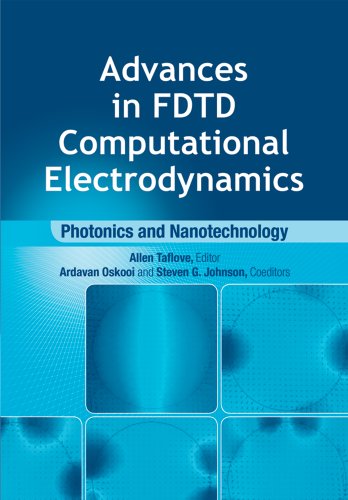


Advances in FDTD Computational Electrodynamics: Photonics and Nanotechnology (Artech House Antennas and Propagation Library)
Price not available for Canada
You can still browse on Amazon. Try another country above.
Book Details
Author(s)
Allen Taflove
Publisher
Artech House
ISBN / ASIN
B00KDNZ9DM
ISBN-13
978B00KDNZ9D3
Marketplace
Canada 🇨🇦
Ratings & Reviews
No reviews yet — be the first!
No reviews yet.
Description
Advances in photonics and nanotechnology have the potential to revolutionize humanity’s ability to communicate and compute. To pursue these advances, it is mandatory to understand and properly model interactions of light with materials such as silicon and gold at the nanoscale, i.e., the span of a few tens of atoms laid side by side. These interactions are governed by the fundamental Maxwell’s equations of classical electrodynamics, supplemented by quantum electrodynamics.
This book presents the current state-of-the-art in formulating and implementing computational models of these interactions. Maxwell’s equations are solved using the finite-difference time-domain (FDTD) technique, pioneered by the senior editor, whose prior Artech House books in this area are among the top ten most-cited in the history of engineering. You discover the most important advances in all areas of FDTD and PSTD computational modeling of electromagnetic wave interactions.
This cutting-edge resource helps you understand the latest developments in computational modeling of nanoscale optical microscopy and microchip lithography. You also explore cutting-edge details in modeling nanoscale plasmonics, including nonlocal dielectric functions, molecular interactions, and multi-level semiconductor gain. Other critical topics include nanoscale biophotonics, especially for detecting early-stage cancers, and quantum vacuum, including the Casimir effect and blackbody radiation.
This book presents the current state-of-the-art in formulating and implementing computational models of these interactions. Maxwell’s equations are solved using the finite-difference time-domain (FDTD) technique, pioneered by the senior editor, whose prior Artech House books in this area are among the top ten most-cited in the history of engineering. You discover the most important advances in all areas of FDTD and PSTD computational modeling of electromagnetic wave interactions.
This cutting-edge resource helps you understand the latest developments in computational modeling of nanoscale optical microscopy and microchip lithography. You also explore cutting-edge details in modeling nanoscale plasmonics, including nonlocal dielectric functions, molecular interactions, and multi-level semiconductor gain. Other critical topics include nanoscale biophotonics, especially for detecting early-stage cancers, and quantum vacuum, including the Casimir effect and blackbody radiation.


