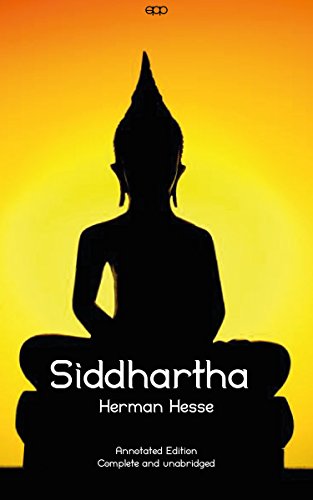


Siddhartha (Annotated)
Book Details
Author(s)
Hesse, Hermann
ISBN / ASIN
B00LDFV1CC
ISBN-13
978B00LDFV1C1
Availability
Available for download now
Category
Kindle Edition
Marketplace
United States 🇺🇸
Ratings & Reviews
No reviews yet — be the first!
No reviews yet.
Description
• New introduction and biography
• Analysis and interpretation of novel
• Complete, unabridged, and formatted for kindle to improve your reading experience
• Linked table of contents to reach your chapter quickly
Siddhartha is a 1922 novel by Hermann Hesse that deals with the spiritual journey of self-discovery of a man named Siddhartha during the time of the Gautama Buddha. The book, Hesse's ninth novel, was written in German, in a simple, lyrical style. It was published in the U.S. in 1951 and became influential during the 1960s.
The word Siddhartha is made up of two words in the Sanskrit language, siddha (achieved) + artha (what was searched for), which together means "he who has found meaning (of existence)" or "he who has attained his goals". In fact, the Buddha's own name, before his renunciation, was Siddhartha Gautama, Prince of Kapilvastu, Nepal. In this book, the Buddha is referred to as "Gotama".
In Hesse’s novel, experience, the totality of conscious events of a human life, is shown as the best way to approach understanding of reality and attain enlightenment – Hesse’s crafting of Siddhartha’s journey shows that understanding is attained not through intellectual methods, nor through immersing oneself in the carnal pleasures of the world and the accompanying pain of samsara; however, it is the completeness of these experiences that allow Siddhartha to attain understanding.
Thus, the individual events are meaningless when considered by themselves—Siddhartha’s stay with the Samanas and his immersion in the worlds of love and business do not lead to nirvana, yet they cannot be considered distractions, for every action and event gives Siddhartha experience, which leads to understanding.
A major preoccupation of Hesse in writing Siddhartha was to cure his 'sickness with life' (Lebenskrankheit) by immersing himself in Indian philosophy such as that expounded in the Upanishads and the Bhagavad Gita. The reason the second half of the book took so long to write was that Hesse had not experienced that transcendental state of unity to which Siddhartha aspires. In an attempt to do so, Hesse lived as a virtual semi-recluse and became totally immersed in the sacred teachings of both Hindu and Buddhist scriptures. His intention was to attain to that 'completeness' which, in the novel, is the Buddha's badge of distinction.
The novel is structured on three of the traditional stages of life for Hindu males -student (brahmacarin), householder (grihastha) and recluse/renunciate (vanaprastha)- as well as the Buddha's four noble truths (Part One) and eight-fold path (Part Two) which form twelve chapters, the number in the novel.
• Analysis and interpretation of novel
• Complete, unabridged, and formatted for kindle to improve your reading experience
• Linked table of contents to reach your chapter quickly
Siddhartha is a 1922 novel by Hermann Hesse that deals with the spiritual journey of self-discovery of a man named Siddhartha during the time of the Gautama Buddha. The book, Hesse's ninth novel, was written in German, in a simple, lyrical style. It was published in the U.S. in 1951 and became influential during the 1960s.
The word Siddhartha is made up of two words in the Sanskrit language, siddha (achieved) + artha (what was searched for), which together means "he who has found meaning (of existence)" or "he who has attained his goals". In fact, the Buddha's own name, before his renunciation, was Siddhartha Gautama, Prince of Kapilvastu, Nepal. In this book, the Buddha is referred to as "Gotama".
In Hesse’s novel, experience, the totality of conscious events of a human life, is shown as the best way to approach understanding of reality and attain enlightenment – Hesse’s crafting of Siddhartha’s journey shows that understanding is attained not through intellectual methods, nor through immersing oneself in the carnal pleasures of the world and the accompanying pain of samsara; however, it is the completeness of these experiences that allow Siddhartha to attain understanding.
Thus, the individual events are meaningless when considered by themselves—Siddhartha’s stay with the Samanas and his immersion in the worlds of love and business do not lead to nirvana, yet they cannot be considered distractions, for every action and event gives Siddhartha experience, which leads to understanding.
A major preoccupation of Hesse in writing Siddhartha was to cure his 'sickness with life' (Lebenskrankheit) by immersing himself in Indian philosophy such as that expounded in the Upanishads and the Bhagavad Gita. The reason the second half of the book took so long to write was that Hesse had not experienced that transcendental state of unity to which Siddhartha aspires. In an attempt to do so, Hesse lived as a virtual semi-recluse and became totally immersed in the sacred teachings of both Hindu and Buddhist scriptures. His intention was to attain to that 'completeness' which, in the novel, is the Buddha's badge of distinction.
The novel is structured on three of the traditional stages of life for Hindu males -student (brahmacarin), householder (grihastha) and recluse/renunciate (vanaprastha)- as well as the Buddha's four noble truths (Part One) and eight-fold path (Part Two) which form twelve chapters, the number in the novel.


