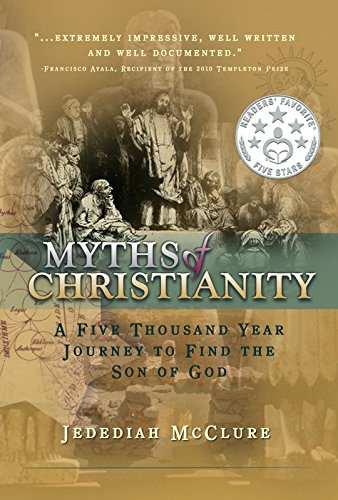


Myths of Christianity: A Five Thousand Year Journey To Find The Son of God
$1.99 PROMOTIONAL SALE
LIMITED TIME ONLY
Myths of Christianity:
A Five Thousand Year Journey To Find The Son of God
FIVE STARS ~ READERS' FAVORITE
Enriches Your Beliefs While Altering Your Previously Held Assumptions
- What exactly makes one a Christian, is it simply a belief in Jesus Christ as the Savior and Redeemer of the world?
- Does someone have to accept the Bible as the sole source of doctrine?
- Would you be shocked to discover that in the Old Testament God repeatedly refers to himself in the plural?
- Would you be surprised to learn that the name Lucifer only appears once in the Bible - as a mistranslation in the Latin?
These, and many other ideas, are explored in depth as Myths of Christianity makes a provocative case that many widely-held beliefs concerning the nature of God, the origin of the Devil and even the identity of the Son of God, may not stem from Christianity at all, but from numerous ancient traditions and religions. A whole new world unfolds as you begin to learn Christianity's origins that you were never taught in Sunday school. If you really want to understand "true" Christianity, you need to find its source. You can only do that through understanding the writings and culture of 1st century Christianity and its myths.
>>> A user friendly guide to Christianity's origins
Both devout and subversive in the best sense, Myths of Christianity provides a fresh and non-divisive perspective on the origins of the world's largest religion even as it affirms the transformative power of Christian principles. In clear, straightforward terms the author sifts through centuries of myths and traditions and assembles extensively researched scholarship into an engaging, relatable, uplifting and often entertaining account of Christianity’s origins.
Anyone can understand the complex historical and cultural influences that helped shape Christianity by following these topics:
- Christians Against Christians
- The Bible and the U.S. Constitution
- God, Angels and the Devil
- The Evolution of God
- Satan: God’s Nemesis
- Angels and Demons
- The Afterlife: Heaven and Hell
- Earthly Gods, Miracles and Magic
- The Ancient Godmen
- Magic and Miracles
- And much, much more...
>>> Why are we so critical of the beliefs of others?
The main goal of this book is to demonstrate that many of the modern traditions tending to divide us as a faith have their origins in foreign myths and legends instead of in Christianity itself. The author's conclusion is that if we truly understood the history and evolution of our own religion, we would not be so critical of the beliefs of others.
Most Helpful Reader Reviews
Grab a copy TODAY.

