

Adaptive Indicators 1°: KAMA e KAMAC (english): A fast & day trading protocol (english) (Fast Trading Series Book 20)
Price not available for Canada
You can still browse on Amazon. Try another country above.
Book Details
Author(s)
Renato Di Lorenzo
Publisher
3
ISBN / ASIN
B00TLPQTEG
ISBN-13
978B00TLPQTE2
Marketplace
Canada 🇨🇦
Ratings & Reviews
No reviews yet — be the first!
No reviews yet.
Description
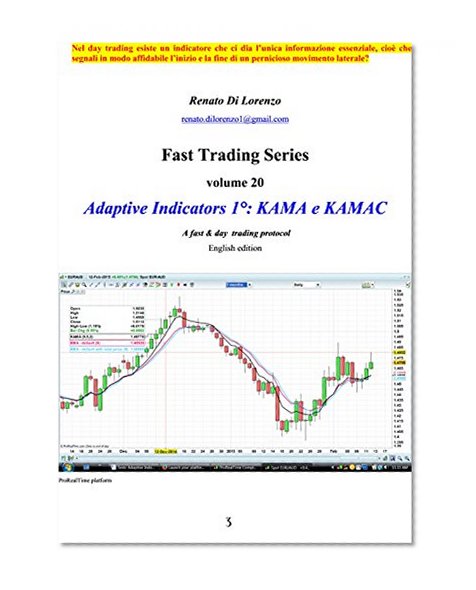
Those who work in day trading continuously throughout the day almost always are forced to operate by visual inspection, because the time and the necessary speed of the decisions do not allow them, or allow them badly, to use a trading system. For this they need indicators that are suitable for the purpose, i.e. that provide the only information really essential in this context, that is the beginning and the end of a pernicious lateral movement. One such indicator is the KAMA (Kaufman Adaptive Moving Average), the effectiveness of which have often fed a lot of doubts, but here we definitely will improve it.
We will also introduce, for those who want it, a new trading system based on a modified version of the same KAMA.
Be adaptive means that the indicator parameters (such as the length of a moving average) does not remain fixed, but vary and adapt to prices using some formula: for example, the length of a moving average may increase or decrease over time depending on the change in price volatility.
Perry Kaufman's KAMA is in fact an example of adaptive moving average.
We will also introduce, for those who want it, a new trading system based on a modified version of the same KAMA.
Be adaptive means that the indicator parameters (such as the length of a moving average) does not remain fixed, but vary and adapt to prices using some formula: for example, the length of a moving average may increase or decrease over time depending on the change in price volatility.
Perry Kaufman's KAMA is in fact an example of adaptive moving average.