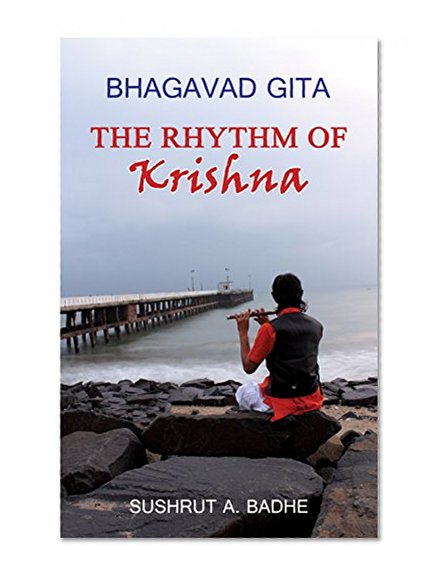


Bhagavad Gita: The Rhythm of Krishna (For All): All Chapters -Sanskrit to English rhymes with original text and transliteration
Price not available for India
You can still browse on Amazon. Try another country above.
Book Details
Author(s)
Sushrut A. Badhe
Publisher
Sushrut A. Badhe
ISBN / ASIN
B0124R8RSS
ISBN-13
978B0124R8RS1
Marketplace
India 🇮🇳
Description
All 700 Sanskrit verses rendered into English rhymes by the Author of India's First Rhyme Book based on Bhagavad Gita- (India Book of Records- Dec 2014)
The original Bhagavad Gita text is written in Sanskrit and the most accurate way of understanding the text is by first learning Sanskrit and then by slowly decoding and deciphering the ancient scripture in its contextual, philological and metaphysical meanings. I have always felt a strong bond of connection with this scripture and it is this bond that encouraged me to attempt in translating the rhythm of the 700 shlokas into poetic English
For reference I have mainly used Sri Aurobindo’s Essays on the Gita, The Gita Press- Gorakhpur Edition and the translations and commentaries on The Gita by the four authorized saints of the Vaishnava Traditions- Sri Vishnuswami, Sri Madhavacharya, Sri Keshava Kashmiri and Sri Ramanuja.
"The Bhagavad Gita is essentially a spiritual book and not a religious text. It is universal in its perspective and all 18 chapters emphasize the need for action for the Lokasangraha- betterment of all peoples of the world.
It speaks not about a material ascetism but instead speaks about embracing every sphere of karma to lead a Divine life on earth.
Throughout the text we hear Arjuna- the chosen one- ask the questions that arise in almost every human heart.
And we also hear the words of Krishna –the manifesting god head-patiently answering all his queries on God, man, life, death, living and being with a love that is truly Divine.
The Gita is integral in all its principles, which can be imbibed by all sections of the society.
It teaches a sage to become a better sage, a warrior to become a better warrior, a businessman to become a better businessman, a politician to become a better politician, a teacher to become a better teacher and a student to become a better student."
I have re-written the Shlokas- which are basically couplets in Sanskrit language into quatrains in simple English.
The numbers at the end of the four line verses are according to the numbers written in the original Sanskrit text. No alterations have been made in the numberings and also the verses have not been grouped purposefully so that each verse may be studied and compared individually. Though Krishna and Arjuna have been glorified by a number of different names in throughout the Bhagavad Gita, I have chosen to maintain homogeneity in their names throughout my rhythmic verses.
For the younger generation that does not have much free time, the verses have been grouped as per the subjects and the groupings are mentioned at the beginning of every Canto.
For those well versed in the Devanagari script –the original Shlokas in Sanskrit language have been provided in this book for their reference and comparison.For those who are unaware of the Devanagari script, an English transliteration has been provided. The Internationational Alphabet of Sanskrit Transliteration (ISAT) scheme of transliteration is provided at the end of the book so that the transliteration may be read out in a phonetically accurate manner.
Also for the readers who are not very familiar with the Sanskrit terms, a glossary of important Sanskrit terms and characters mentioned in the English verses has been provided.
The original Bhagavad Gita text is written in Sanskrit and the most accurate way of understanding the text is by first learning Sanskrit and then by slowly decoding and deciphering the ancient scripture in its contextual, philological and metaphysical meanings. I have always felt a strong bond of connection with this scripture and it is this bond that encouraged me to attempt in translating the rhythm of the 700 shlokas into poetic English
For reference I have mainly used Sri Aurobindo’s Essays on the Gita, The Gita Press- Gorakhpur Edition and the translations and commentaries on The Gita by the four authorized saints of the Vaishnava Traditions- Sri Vishnuswami, Sri Madhavacharya, Sri Keshava Kashmiri and Sri Ramanuja.
"The Bhagavad Gita is essentially a spiritual book and not a religious text. It is universal in its perspective and all 18 chapters emphasize the need for action for the Lokasangraha- betterment of all peoples of the world.
It speaks not about a material ascetism but instead speaks about embracing every sphere of karma to lead a Divine life on earth.
Throughout the text we hear Arjuna- the chosen one- ask the questions that arise in almost every human heart.
And we also hear the words of Krishna –the manifesting god head-patiently answering all his queries on God, man, life, death, living and being with a love that is truly Divine.
The Gita is integral in all its principles, which can be imbibed by all sections of the society.
It teaches a sage to become a better sage, a warrior to become a better warrior, a businessman to become a better businessman, a politician to become a better politician, a teacher to become a better teacher and a student to become a better student."
I have re-written the Shlokas- which are basically couplets in Sanskrit language into quatrains in simple English.
The numbers at the end of the four line verses are according to the numbers written in the original Sanskrit text. No alterations have been made in the numberings and also the verses have not been grouped purposefully so that each verse may be studied and compared individually. Though Krishna and Arjuna have been glorified by a number of different names in throughout the Bhagavad Gita, I have chosen to maintain homogeneity in their names throughout my rhythmic verses.
For the younger generation that does not have much free time, the verses have been grouped as per the subjects and the groupings are mentioned at the beginning of every Canto.
For those well versed in the Devanagari script –the original Shlokas in Sanskrit language have been provided in this book for their reference and comparison.For those who are unaware of the Devanagari script, an English transliteration has been provided. The Internationational Alphabet of Sanskrit Transliteration (ISAT) scheme of transliteration is provided at the end of the book so that the transliteration may be read out in a phonetically accurate manner.
Also for the readers who are not very familiar with the Sanskrit terms, a glossary of important Sanskrit terms and characters mentioned in the English verses has been provided.
