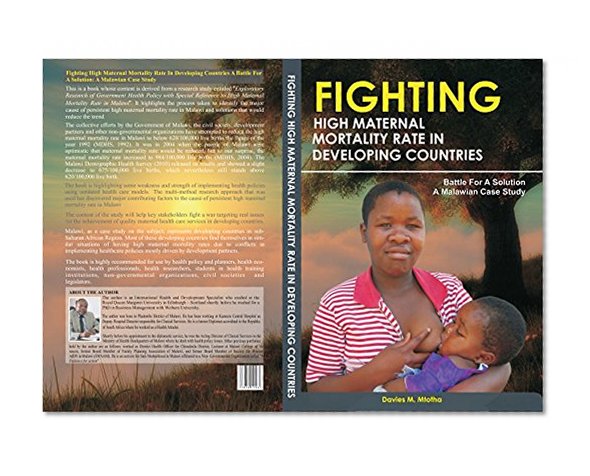


FIGHTING HIGH MATERNAL MORTALITY RATE IN DEVELOPING COUNTRIES: BATTLE FOR A SOLUTION: A MALAWIAN CASE STUDY
Book Details
Author(s)
Davies .M Mtotha
Publisher
Davies M. Mtotha
ISBN / ASIN
B01DBY06WS
ISBN-13
978B01DBY06W3
Sales Rank
#599,535
Marketplace
United States 🇺🇸
Ratings & Reviews
No reviews yet — be the first!
No reviews yet.
Description
The content of this book is derived from a research conducted from 2009 to 2014 entitled “Exploratory Research of Government Health Policy with Special Reference to High Maternal Mortality rate in Malawi”. The author studied contributing factors of high maternal mortality rate in Malawi. Malawi is one of the countries in the sub-Saharan Region which has high Maternal Mortality Rate of 675/100,000 live births.
There has been a collective action from the public, civil society, and non-governmental organizations in the fight against high maternal mortality rate in Malawi. Despite all attempts to reduce the high maternal mortality rate in the past decade of years, maternal mortality rate increased from 620 per 100,000 live births in 1992 to 1,120 live births in the year 2000 (MDHS 2000 cited in MDHS, 2004: xxii). The figure slightly decreased to 984/100,000 live births in the year 2004.
The results of the Malawi Demographic Health Survey of 2010 showed a reduction of maternal mortality rate to 675 per 100,000 live births. The figure is still worse since it is above the average maternal mortality rate for all countries in the sub-Saharan Region currently at 500 per 100,000 live births.
The Health Sector Strategic Plan (2010 – 2016) states that Malawi may not be able to achieve the Millennium Development Goal set for 2015. The question frequently asked is, ‘What is the main contributing factor to this phenomenon?
The book reveals some important policy issues that need to be considered in the fight against the high maternal mortality rate in Malawi.
The book is expected to be useful primarily to health policy professionals, hospital managers, health planners, health economists, health researchers, and students pursuing public health studies.
There has been a collective action from the public, civil society, and non-governmental organizations in the fight against high maternal mortality rate in Malawi. Despite all attempts to reduce the high maternal mortality rate in the past decade of years, maternal mortality rate increased from 620 per 100,000 live births in 1992 to 1,120 live births in the year 2000 (MDHS 2000 cited in MDHS, 2004: xxii). The figure slightly decreased to 984/100,000 live births in the year 2004.
The results of the Malawi Demographic Health Survey of 2010 showed a reduction of maternal mortality rate to 675 per 100,000 live births. The figure is still worse since it is above the average maternal mortality rate for all countries in the sub-Saharan Region currently at 500 per 100,000 live births.
The Health Sector Strategic Plan (2010 – 2016) states that Malawi may not be able to achieve the Millennium Development Goal set for 2015. The question frequently asked is, ‘What is the main contributing factor to this phenomenon?
The book reveals some important policy issues that need to be considered in the fight against the high maternal mortality rate in Malawi.
The book is expected to be useful primarily to health policy professionals, hospital managers, health planners, health economists, health researchers, and students pursuing public health studies.
