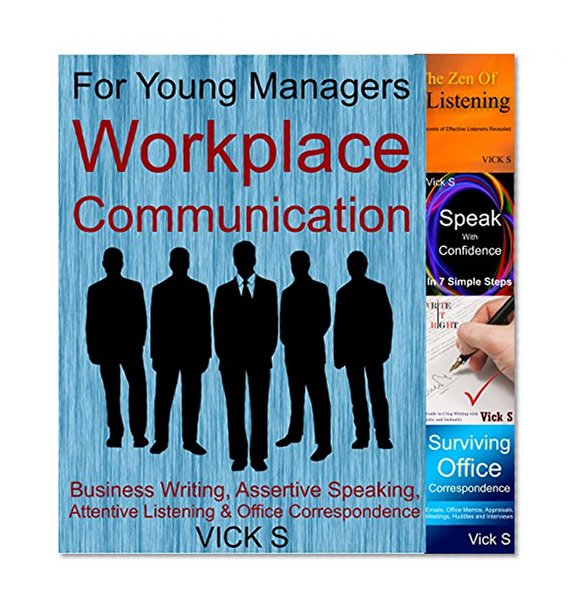


Workplace Communication: Business Writing, Assertive Speaking, Attentive Listening & Office Correspondence (Business Communication)
Book Details
Author(s)
Vick S
ISBN / ASIN
B01DFHLRIS
ISBN-13
978B01DFHLRI9
Sales Rank
#500,222
Marketplace
United States 🇺🇸
Description
Why this book?
The purpose of this book is to hand-hold, mentor and assist the new and young managers in their professional journey. This book elucidates several key principles, based on my practical insights in the corporate world, for effective communication in the workplace.
The language of the book is simple. I don’t believe in complicated indigestible ideas, or in complex idioms pregnant with nebulous meaning. The principles in this book are simple, short and smart. However, the real value lies in execution. I suggest that you implement these simple ideas and then monitor the results.
What we cover?
We will cover the following areas in this book.
• Listening.
Effective and attentive listening is very important in workplace communication. Many staff members pay a lot of attention to effective speaking and writing, but listening is often ignored. This is dangerous. As a new and young manager you are or will eventually become responsible for managing teams – effective listening is an important skill that will help a new or young manager to handle the teams well.
• Speaking.
In the next section we discuss how to speak assertively and with confidence. Speaking is a very important aspect of effective workplace communication. When you are a manager, leading a team, you don’t want to be misunderstood. We discuss how to assimilate one’s thoughts, and make an effective delivery. We also discuss how to make a proper closure to ensure that the expectations are set right.
• Writing.
All of us know how to write. In this section we will discover how to write to create the right impact. We discuss the few mistakes that new/young managers make in their writing, which leads to unclear or incomplete communication. We discuss few simple and effective tips and tricks to derive clarity in writing.
• Handling office correspondence.
A new or young manager struggles with a plethora of correspondence in a day. The day is full of emails, meetings, office memorandums, conducting appraisals, conducting hiring interviews etc. How does the manager deal with all this office correspondence? How does the manager handle volatile appraisals? How does a manager spot the right talent in hiring interviews?
Who is this book for?
This book has been written for all new and young managers. The language is intentionally kept very simple. Even those whose first language is not English will benefit from this book. The principles are universal and practical, based on my years of experience in the corporate world. These are not solutions to non-existent problems. Rather simple solutions to everyday problems that real life new and young managers face.
This book should be most useful to the following audience:
• A new manager who has entered the corporate world, and trying to find his or her feet in this slippery area.
• A manager who has recently moved on from role of individual contributor to team management i.e. from being responsible for doing work, to being responsible for getting work done from others.
• Staff aspiring to move on to the role of team managers.
• Persons dealing with tasks of listening, speaking, writing, or dealing with office correspondence as part of their office duties.
• People interested in a practical and pragmatic approach to workplace communication, rather than theory.
• People looking for specific tips and tricks for improving their workplace communication skills.
• Any person generally interested in principles of good and effective communication.
Take action now
What are you waiting for? Take action now. Click the Buy button, and let’s get rolling.
Note
This book compiles content from 4 booklets: The Zen of Listening, Speak with Confidence, Write It Right and Surviving Office Correspondence.
The purpose of this book is to hand-hold, mentor and assist the new and young managers in their professional journey. This book elucidates several key principles, based on my practical insights in the corporate world, for effective communication in the workplace.
The language of the book is simple. I don’t believe in complicated indigestible ideas, or in complex idioms pregnant with nebulous meaning. The principles in this book are simple, short and smart. However, the real value lies in execution. I suggest that you implement these simple ideas and then monitor the results.
What we cover?
We will cover the following areas in this book.
• Listening.
Effective and attentive listening is very important in workplace communication. Many staff members pay a lot of attention to effective speaking and writing, but listening is often ignored. This is dangerous. As a new and young manager you are or will eventually become responsible for managing teams – effective listening is an important skill that will help a new or young manager to handle the teams well.
• Speaking.
In the next section we discuss how to speak assertively and with confidence. Speaking is a very important aspect of effective workplace communication. When you are a manager, leading a team, you don’t want to be misunderstood. We discuss how to assimilate one’s thoughts, and make an effective delivery. We also discuss how to make a proper closure to ensure that the expectations are set right.
• Writing.
All of us know how to write. In this section we will discover how to write to create the right impact. We discuss the few mistakes that new/young managers make in their writing, which leads to unclear or incomplete communication. We discuss few simple and effective tips and tricks to derive clarity in writing.
• Handling office correspondence.
A new or young manager struggles with a plethora of correspondence in a day. The day is full of emails, meetings, office memorandums, conducting appraisals, conducting hiring interviews etc. How does the manager deal with all this office correspondence? How does the manager handle volatile appraisals? How does a manager spot the right talent in hiring interviews?
Who is this book for?
This book has been written for all new and young managers. The language is intentionally kept very simple. Even those whose first language is not English will benefit from this book. The principles are universal and practical, based on my years of experience in the corporate world. These are not solutions to non-existent problems. Rather simple solutions to everyday problems that real life new and young managers face.
This book should be most useful to the following audience:
• A new manager who has entered the corporate world, and trying to find his or her feet in this slippery area.
• A manager who has recently moved on from role of individual contributor to team management i.e. from being responsible for doing work, to being responsible for getting work done from others.
• Staff aspiring to move on to the role of team managers.
• Persons dealing with tasks of listening, speaking, writing, or dealing with office correspondence as part of their office duties.
• People interested in a practical and pragmatic approach to workplace communication, rather than theory.
• People looking for specific tips and tricks for improving their workplace communication skills.
• Any person generally interested in principles of good and effective communication.
Take action now
What are you waiting for? Take action now. Click the Buy button, and let’s get rolling.
Note
This book compiles content from 4 booklets: The Zen of Listening, Speak with Confidence, Write It Right and Surviving Office Correspondence.
