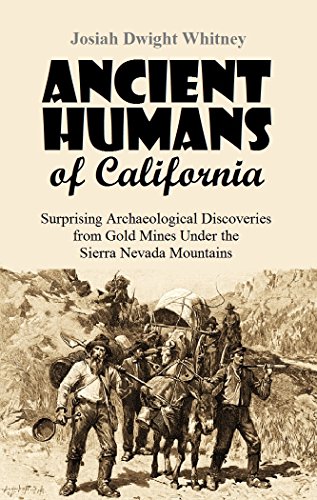


Ancient Humans of California: Surprising Archaeological Discoveries from Gold Mines Under the Sierra Nevada Mountains (1880 Article)
Book Details
Author(s)
Josiah Dwight Whitney
ISBN / ASIN
B071DCXJ7T
ISBN-13
978B071DCXJ79
Sales Rank
#386,779
Marketplace
United States 🇺🇸
Description
"Ancient Humans of California" is a reprint of an article by J.D. Whitney, published in "AMERICAN GEOLOGY, VOL. 1, OF THE MUSEUM OF COMPARATIVE ZOOLOGY AT CAMBRIDGE, UNIVERSITY PRESS, 1880. " Excerpted for this book is a section from his article titled: “THE AURIFEROUS GRAVELS OF THE SIERRA NEVADA OF CALIFORNIA.”
This excerpted section discusses human relics found in gravel under lava beds which antedates the principal elevation of the Sierra Nevada range, and represents a period in which the animal and plant life of the earth differed entirely from that of the present day. On February 25, 1866, miners found a human skull in a mine, beneath a layer of lava, 130 feet below the surface of the earth, which made it into the hands of Josiah Whitney (1819 –1896), then the State Geologist of California as well as a Professor of Geology at Harvard University. Contrary to what might have been expected, the form of the skull after it had been cleaned and prepared for study was not found to differ materially from that of modern California Indians. Man was thus apparently shown to have survived several total changes that have occurred in the life of the earth since the time of accumulation of the gravels, yet without having undergone any modification of his own physical structure.
The name of this eminent geologist Whitney has for many years been associated with the Calaveras skull, which was found in a shaft 130 feet deep, under five beds of lava and volcanic tufa, and four beds of auriferous gravel. The discovery was so astounding that it was not fully credited, although it is cited and accepted by Dr. Foster in his “ Pre-historic Races of the United States,” published in 1873. Bancroft, also, in his “Native Races of the Pacific States,” cites a large number of cases in which stone mortars, weapons, etc., have been found in California, in Table Mountain, Tuolumne County, and elsewhere, at great depths.
A year before the skull came to his attention, Whitney published the belief that humans, mastodons, and elephants coexisted; the skull served as proof of his convictions. After careful study, he officially announced its discovery at a meeting of the California Academy of Sciences on July 16, 1866, declaring it evidence of the existence of Pliocene age man in North America, which would make it the oldest known record of humans on the continent.
In this article Whitney defends the authenticity of the discoveries and provides affidavits supporting authenticity.
This excerpted section discusses human relics found in gravel under lava beds which antedates the principal elevation of the Sierra Nevada range, and represents a period in which the animal and plant life of the earth differed entirely from that of the present day. On February 25, 1866, miners found a human skull in a mine, beneath a layer of lava, 130 feet below the surface of the earth, which made it into the hands of Josiah Whitney (1819 –1896), then the State Geologist of California as well as a Professor of Geology at Harvard University. Contrary to what might have been expected, the form of the skull after it had been cleaned and prepared for study was not found to differ materially from that of modern California Indians. Man was thus apparently shown to have survived several total changes that have occurred in the life of the earth since the time of accumulation of the gravels, yet without having undergone any modification of his own physical structure.
The name of this eminent geologist Whitney has for many years been associated with the Calaveras skull, which was found in a shaft 130 feet deep, under five beds of lava and volcanic tufa, and four beds of auriferous gravel. The discovery was so astounding that it was not fully credited, although it is cited and accepted by Dr. Foster in his “ Pre-historic Races of the United States,” published in 1873. Bancroft, also, in his “Native Races of the Pacific States,” cites a large number of cases in which stone mortars, weapons, etc., have been found in California, in Table Mountain, Tuolumne County, and elsewhere, at great depths.
A year before the skull came to his attention, Whitney published the belief that humans, mastodons, and elephants coexisted; the skull served as proof of his convictions. After careful study, he officially announced its discovery at a meeting of the California Academy of Sciences on July 16, 1866, declaring it evidence of the existence of Pliocene age man in North America, which would make it the oldest known record of humans on the continent.
In this article Whitney defends the authenticity of the discoveries and provides affidavits supporting authenticity.

